Rethinking AI in PSA: How iBE Is Building a Scalable, Future-Ready Foundation
AI has found its way into almost every enterprise product, but in many professional services automation (PSA) systems, it still feels like an add-on. A feature here, a chatbot there, a one-off automation stitched into a workflow. The result is often fragmented, difficult to scale, and tightly tied to specific vendors or models.
At iBE, we have taken a different approach. Instead of asking, “Where can we add AI?”, we asked a more fundamental question: How should AI exist inside a PSA system in the first place?
Moving Beyond Feature-Based AI
One of the biggest limitations in traditional PSA AI adoption is how it is implemented. AI is often embedded directly into business logic, making workflows dependent on a specific model or provider. That creates friction the moment anything changes, whether a better model becomes available, costs shift, or compliance requirements evolve.
This approach does not scale. It locks organizations into decisions that should remain flexible.
What is needed instead is not just a collection of AI features, but a robust, adaptable foundation.
Introducing a Decoupled AI Framework in iBE
iBE’s AI framework is built on a simple but powerful principle: AI should enhance workflows, not control them.
To achieve this, AI capabilities are architected as a separate, intelligent layer that integrates seamlessly into PSA processes without being tightly bound to them. Business logic continues to operate independently, while AI acts as an augmentation layer that can evolve over time.
This separation delivers a significant advantage. AI models can be upgraded, replaced, or diversified without disrupting core operations. Organizations can experiment, improve, and adopt new innovations without being locked into early technology choices. The PSA platform remains stable even as AI continues to evolve at remarkable speed.
Built on Core Principles for Enterprise Scale
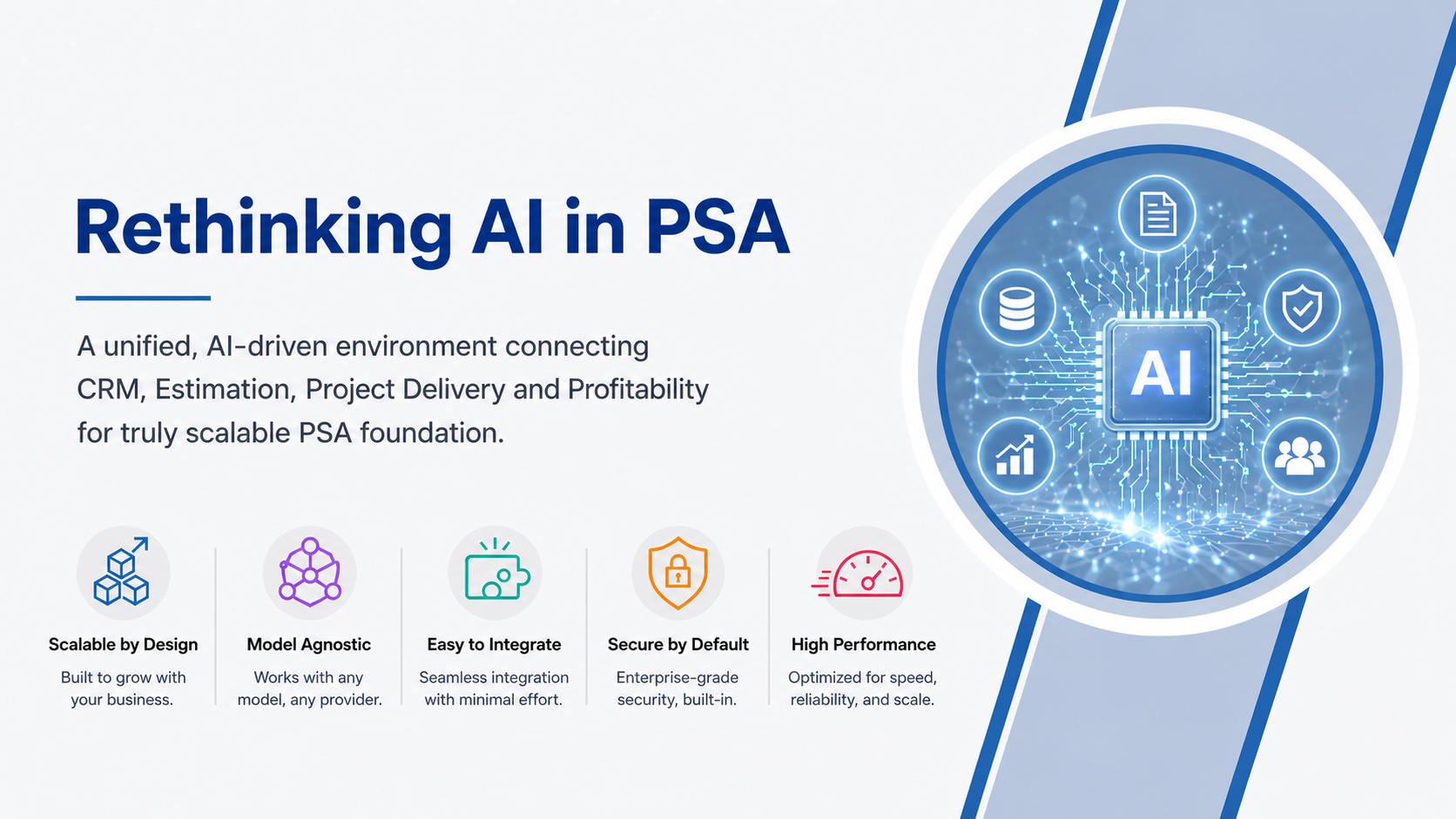
The iBE AI framework is designed around a set of principles that ensure it remains practical, adaptable, and enterprise-ready.
Scalable by Design: AI services are modular, reusable, and designed to grow across modules, users, and business scenarios without requiring rework. The architecture supports horizontal expansion, enabling new AI use cases to be introduced without refactoring existing capabilities. Whether scaling across clients, projects, or peak operational cycles, the framework is built to grow with the business.
Flexible and Model-Agnostic: The framework supports multiple AI models and providers, including OpenAI, Gemini, and future local or edge-based models. This model-agnostic design prevents vendor lock-in while allowing organizations to choose the right model for each task. It also supports both real-time, synchronous interactions and long-running, asynchronous AI workloads, making it suitable for a wide range of enterprise scenarios.
Easy to Integrate: AI capabilities are exposed through business-level services such as contract review, contextual chat, and intelligent invoice processing. They integrate cleanly with existing APIs, data models, and service layers, using standardized JSON inputs and outputs compatible with REST and event-driven architectures. This allows AI to fit naturally into existing workflows rather than forcing workflows to adapt to AI.
Secure by Default: AI execution follows the same enterprise-grade security model as the core iBE platform. Strict client isolation, role-based access controls, and authorization checks are enforced before any AI service is invoked. Sensitive data is never shared with AI systems without explicit context and approval, ensuring data privacy and regulatory compliance at every step.
High Performance: The framework is optimized for low-latency interactions in active PSA workflows. For heavier workloads, asynchronous processing ensures performance remains consistent. Intelligent caching of embeddings, contextual data, and intermediate results further improves responsiveness while reducing unnecessary computational overhead.
Responsible AI at the Core
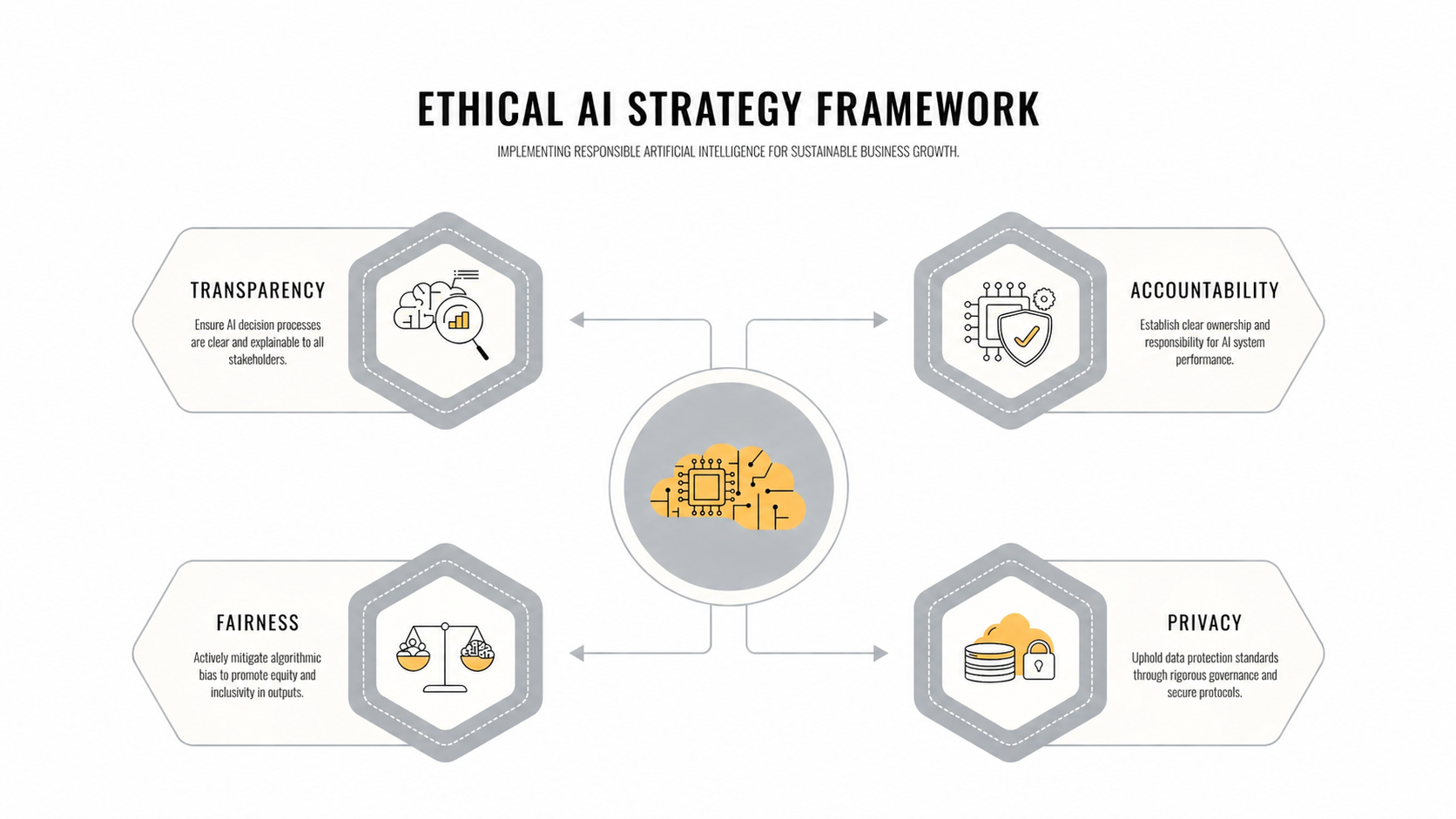
Transparency: At iBE, transparency is central to building trust in AI. Users should always know when they are interacting with AI, what role it is playing, and how it contributes to outcomes. AI-generated insights, recommendations, and actions are clearly identified within the user experience. This clarity helps users understand where automation is involved, where human judgment is required, and how decisions are being supported.
Accountability: AI should enhance responsibility, not obscure it. At iBE, accountability is built into every AI-driven workflow. Clear ownership is maintained for decisions, actions, and outcomes, ensuring that humans remain ultimately responsible. AI recommendations can be reviewed, validated, and overridden, while comprehensive audit trails provide visibility into how decisions were made and acted upon.
Fairness: Fairness is essential to trustworthy AI. iBE is committed to designing AI systems that minimize bias and promote equitable outcomes across users, roles, and scenarios. Models are continuously evaluated for unintended bias, and safeguards are implemented to ensure decisions are consistent, inclusive, and aligned with ethical standards. This helps create AI solutions that serve all users fairly and responsibly.
Privacy: Privacy is a fundamental requirement, not an optional feature. iBE designs AI systems with privacy by default, ensuring that data is handled securely, responsibly, and in compliance with applicable regulations. Sensitive information is protected through robust access controls, encryption, and data governance practices. Users can trust that their data is used only for its intended purpose and safeguarded throughout its lifecycle.
Designed for Real Enterprise Complexity
PSA systems sit at the center of business operations, connecting sales, delivery and compliance. Any meaningful AI strategy must work across this entire lifecycle. That is exactly what the iBE framework enables.
AI can be consistently applied across functions, from validating commercial documents and improving estimation accuracy to surfacing project risks and strengthening financial controls. More importantly, it does so within a governed framework that ensures every AI interaction remains secure, traceable, and aligned with enterprise requirements.
This is not simply intelligence. It is responsible intelligence at scale.
A Blueprint for Continuous Innovation
Rather than reinventing AI capabilities for every new feature, iBE provides a shared architectural blueprint for how AI is built, integrated, and extended across the platform.
This creates consistency, reduces duplication, and accelerates innovation. Over time, AI becomes more than a collection of isolated enhancements. It becomes a systematic capability embedded throughout the PSA platform.
AI That Evolves Without Disruption
AI is evolving faster than any other layer in enterprise technology. New models, techniques, and possibilities emerge constantly.
A rigid architecture struggles to keep pace. A decoupled framework is built for exactly this kind of change.
Within iBE, AI capabilities can evolve independently of the PSA core. Businesses can take advantage of the latest advancements without reengineering existing systems, disrupting operations, or compromising stability.
Within iBE, AI capabilities can evolve independently of the PSA core. Businesses can take advantage of the latest advancements without reengineering existing systems, disrupting operations, or compromising stability.
From Framework to Real Business Impact
This foundation is already enabling meaningful, real-world applications within iBE.
AI-driven contract validation can compare quotations and purchase orders to identify discrepancies before they become risks. Estimation processes are becoming more intelligent and aligned with actual delivery outcomes. Project management is becoming increasingly predictive, helping teams identify risks earlier and make better decisions.
These are not isolated features. They are the practical outcomes of a deeper architectural strategy.
The Bigger Picture
The real story is not about adding AI to PSA. It is about designing a PSA platform for an AI-first world.
By building a scalable, flexible, secure, high-performance, and responsible AI framework, iBE is creating a platform where intelligence can grow continuously, without friction, without vendor lock-in, and without compromising stability.
This transforms PSA from a system of record into a system of intelligence: one that not only tracks what is happening, but actively helps shape better outcomes.