Change Fatigue Is Real – Here’s How Leaders Can Make Transformation Stick
Introduction: The Saturation Point Has Arrived
Digital Transformations are reaching a saturation point.
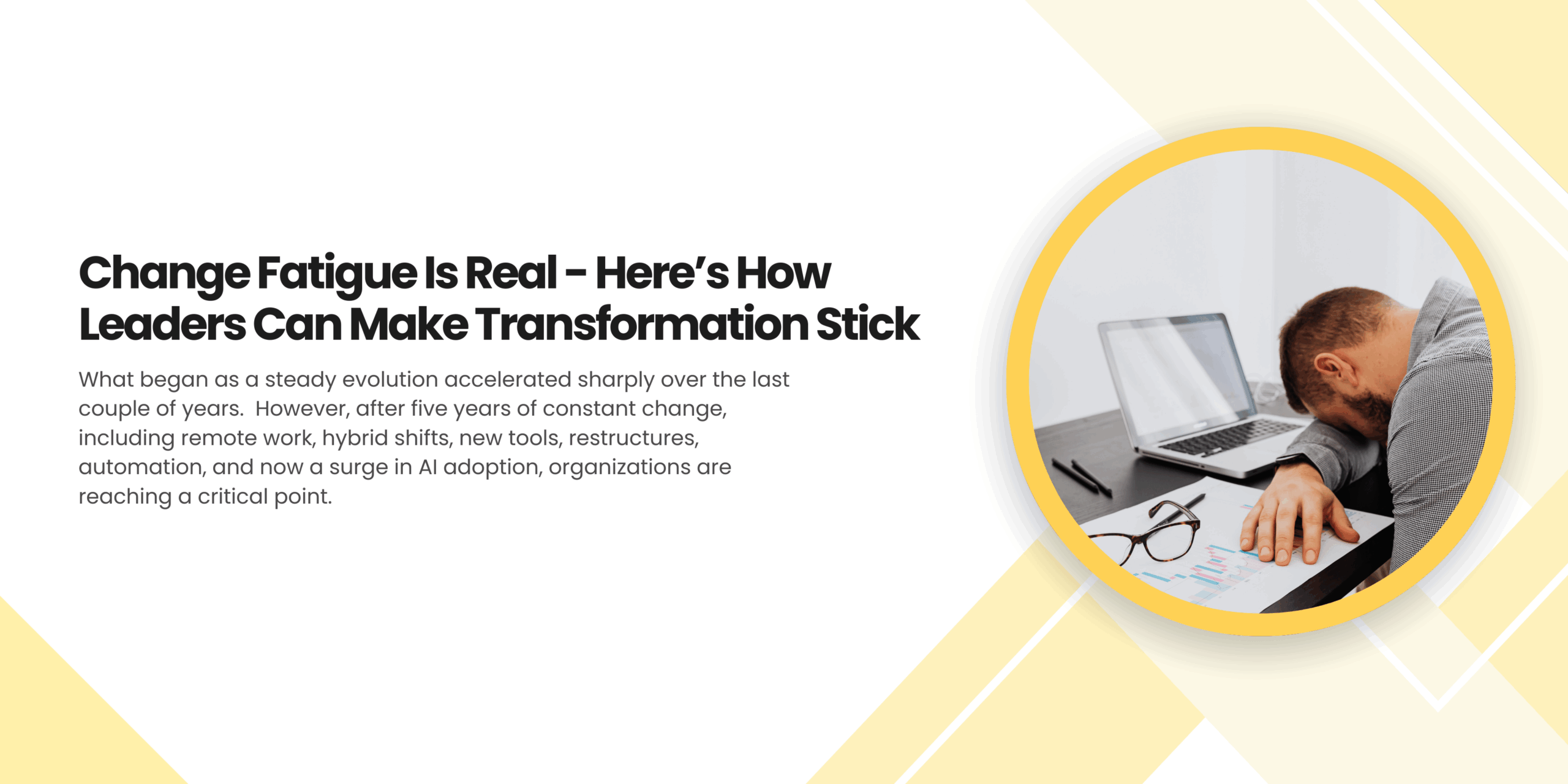
What began as a steady evolution accelerated sharply over the last couple of years. However, after five years of constant change, including remote work, hybrid shifts, new tools, restructures, automation, and now a surge in AI adoption, organizations are reaching a critical point.
In 2025, teams aren’t resisting change. They’re overwhelmed by the volume of it.
Multiple industry studies, including reports from Productiv, Okta and BetterCloud, show the average mid-sized business now uses between 70 and 120 SaaS tools. With new workflows evolving every quarter, what once felt like progress now often feels like pressure.
This is the root of change fatigue. It creates invisible workload pressure that disrupts transformation efforts, slows adoption, and erodes trust.
But here’s the opportunity:
Leaders who are willing to reshape transformation for clarity, not speed, will create healthier, more adaptable organizations.
1. Why Change Fatigue Is Different in 2025
Change fatigue isn’t new, but its scale and intensity in 2025 are unprecedented.
-
1.1AI adoption is speeding up faster than people can keep up.
Every month brings a new AI tool or workflow update. Meanwhile, teams are still trying to learn the previous rollout. The pace of change has surpassed the pace of learning. -
1.2Tool overload has reached an unsustainable peak.
SaaS sprawl is now one of the biggest factors contributing to cognitive load. Every tool comes with its own:- Terminology
- UI
- Data
- Workflows
This fragmentation wears people down. -
1.3Transformation has become continuous, not cyclical.
Organizations no longer have transformation periods. Transformation is now constant, and teams have no recovery time. -
1.4Leaders underestimate cognitive load.
Employees aren’t struggling with change itself. They’re struggling with the volume, frequency, and fragmentation of change.
2. The Leadership Shift Required in 2025
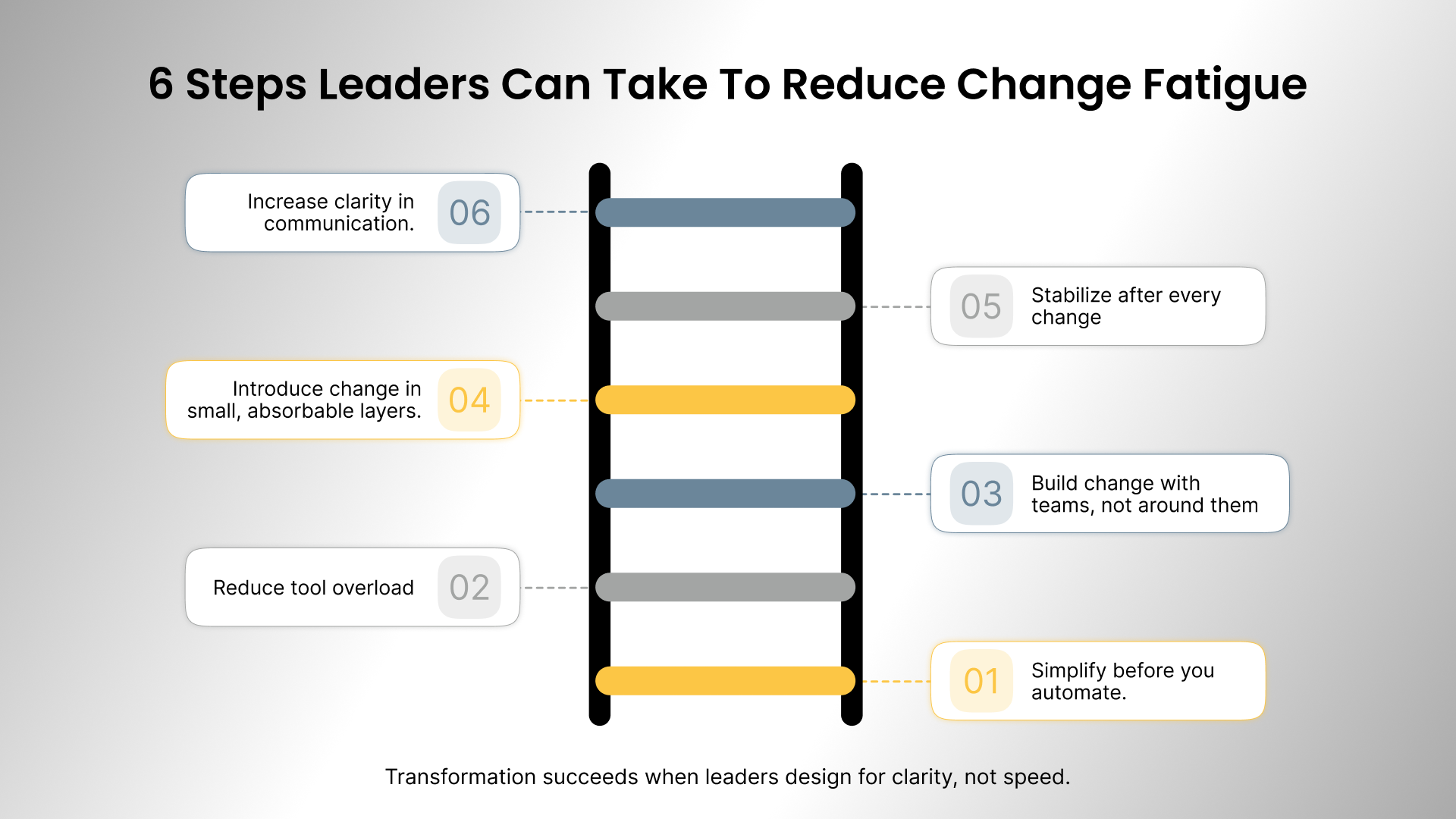
Leaders need a new mindset to make transformation sustainable.
-
2.1Simplify workflow before you automate
Automating a siloed workflow just makes it a faster siloed workflow. The first step is clarity, followed by structure, and then automation. -
2.2Reduce the number of fragmented tools
Each additional tool creates micro-stress and micro-learning. SaaS consolidation is no longer an IT strategy — it is a people-driven strategy.- audit all tools
- eliminate redundant ones
- integrate disconnected ones
- map workflows end-to-end
-
2.3Collaborate with end users in the change
User adoption usually happens naturally when people help shape the workflows they use. Co-creation reduces resistance and increases ownership. Enable adoption, don’t enforce it. -
2.4Introduce change in smaller, manageable stages
Big-bang rollouts cause unnecessary anxiety. Small rollouts build confidence and give teams time to learn. -
2.5First stabilize, then scale
After every change, teams need a “steady state” to build competence. Transformation normally becomes chaos without stabilization. -
2.6Invest in people enablement, not just technology
Training, coaching, open communication, and feedback turn tools into capabilities.
Every transformation budget should include:- Training
- Coaching
- Communication
- Workflow support
- Adoption metrics
Technology without enablement is exhaustion.
3. What We’ve Learned at iBE
We have learned a consistent truth while working with services organizations across engineering, IT, consulting, and other professional services over the past decade:
Change fatigue doesn’t really come from people. It arises from fragmented systems and unclear workflows.
When data resides in multiple tools, transformation becomes a challenge. But when processes exist in a single connected flow, the shift becomes lighter and adoption really speeds up.
Here’s how iBE helps organizations reduce change fatigue:
-
3.1One integrated platform reduces tool overload
As much as possible, have one common system for CRM, Projects, Time, Billing, Finance. Sometimes migrating all processes to one system may not be practical; in that case, optimize and consolidate wherever you can. As a guideline, you should not have to switch between 6–10 apps to complete a workflow. -
3.2Standardized workflows create stability
Teams know exactly:- what to do
- when to do it
- who approves
- what happens next
Predictability reduces anxiety. -
3.3Phased adoption is built into the platform
Organizations activate modules gradually, not all at once. -
3.4Real-time dashboards remove reporting stress
Teams no longer rush to gather data. Visibility and clarity is always available. -
3.5Automation frees cognitive space
Approvals, billing triggers, timesheet reminders, and reconciliations become background processes. When the system reduces friction, people regain capacity.
4. The Future of Transformation: Sustainable, Clear, Human-Centered
The organizations that will thrive in 2025 and beyond won’t be the ones adopting AI the fastest. They’ll be the ones adopting change in a way people can absorb.
Leaders who invest in:
- Clarity
- Consolidation
- Collaboration
- Stability
- Enablement
will see transformation change from a chaos into a steady process of adjusting, from responding to pressure to taking purposeful action.
The real question for 2025 isn’t: How fast can we transform?
It’s: How do we design transformation that people have the capacity to sustain?
Most transformations fail not because of technology gaps, but because leaders underestimate people’s cognitive load.
Sustainable transformation is not about velocity but clarity.