
Beyond Automation: How AI Is Becoming the Brain of Professional Services Firms
Introduction
In 2026, AI is no longer a technological add-on but it is fast becoming a core business capability. AI is moving well beyond basic automation and reshaping how work actually gets done in professional services organizations.
AI is helping teams operate faster, accurately, and more consistently resulting in huge productivity gains. Some of the examples include automation of repetitive tasks such as document review and scheduling, streamlining of internal operations like resume screening and project management and even developing code and testing.
It is also enhancing data analysis by discovering trends, identifying risks, and enabling smarter choices.
At customer’s ends, intelligent chatbots and personalized interactions are resulting in improved responsiveness and experience. This is freeing experts to focus on high-value, meaningful strategic work in consulting, engineering, and legal.
The Rise of AI in Professional Services
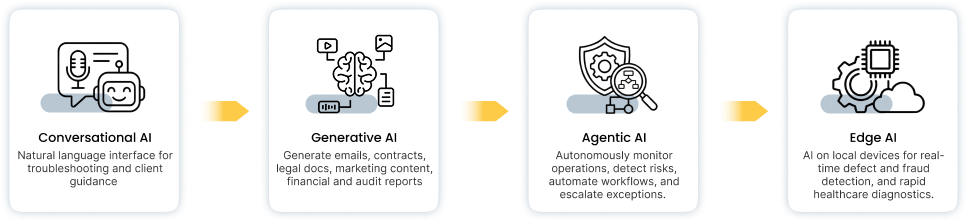
The AI technology, and the way it is used in Professional Services, has seen dramatic evolution over the past decade. It has progressed from basic conversational AI (early 2010s) for simple queries, to generative AI (late 2010s) for content creation, and is now entering the era of agentic AI (present), which focuses on autonomous, goal-oriented action and decision-making. Edge AI complements these by enabling faster, on-device processing.
Conversational AI to Present
- Early stages (2010-2022): Began as simple, rule-based chatbots that could only respond to specific, pre-defined queries (e.g., “Press 1 for balance”). They recognized intent but could not take action across different systems. Later, it evolved into more sophisticated systems that could hold natural, multi-turn conversations and retain basic context.
- In professional services, these assistants improved initial troubleshooting and client guidance but still required human intervention for most complex tasks.
Generative AI (GenAI)
- Emergence (2018-2023): Marked a significant shift by enabling machines to produce original content (text, code, images, reports) rather than just recognize patterns.
- In Professional Services, the impact of GenAI has been tremendous in drafting emails, contracts, legal documents, summarizing vast financial reports, generating audit reports, and creating personalized marketing content. It acts as a powerful assistant for creativity and data analysis.
Agentic AI
- Arrival (2024-Present): Agentic AI represents the current trend where AI is moving beyond generation to autonomous action. Agents can understand a high-level goal, plan the necessary steps, connect to tools, APIs, and execute complex tasks with minimal human intervention.
- In professional services, Agentic AI is slated to be a game-changer as it continuously watches operations, detects risks (like compliance gaps or project delays), triggers workflows, and escalates only the unusual cases, turning humans into supervisors rather than manual operators.
Edge AI
- Integration: Edge AI involves processing data locally on devices rather than relying solely on the cloud, enabling faster, real-time decision-making.
- This is particularly important in professional services for instantaneous or onsite applications like real-time defect detection on field or fraud detection in financial transactions or immediate diagnostics in healthcare, where latency is a critical factor.
The Integrated Future
The trend is towards powerful systems that combine these: Agentic AI leveraging Generative AI’s understanding for reasoning, deployed via Edge AI for efficiency, to create truly autonomous digital workers that can understand, create, plan, and act across complex workflows.
Key Trends in AI Adoption
For professional services in 2026, key AI trends focus on Agentic AI for autonomous workflows, Hyper-Automation, Industry-Specific Models, AI Governance for risk, and the rise of Small Language Models (SLMs) for efficiency. These trends are driving top-down, enterprise-wide strategies for real ROI, moving beyond basic copilots to integrated, intelligent operations and enhanced decision-making.
Enterprise AI Strategy
A shift from scattered experiments to centralized AI programs with top-down leadership driving focused investments in high-impact workflows for measurable ROI.
Agentic AI & Hyper-Automation
Autonomous AI agents to run complete workflows across projects, support, and back-office functions. Working together, they handle entire processes, not just individual tasks. They resolve full support tickets, manage Finance, HR, and Compliance, and coordinate client delivery. For example, a sales agent can work with finance for validation and inventory for stock checks to complete a smooth workflow.
Integrated Ethics, Governance & Trust
Responsible AI frameworks are a top priority, with 72% of CEOs emphasizing them, alongside growing concerns about data, skills, and integration challenges. Proactive risk management with human-in-the-loop controls, audit trails, policy enforcement, transparency, and compliance built in.
Industry-Specific Models
Domain-tuned AI systems designed for regulated, specialized workflows — deeper accuracy, safer adoption.
Small Language Models (SLMs) & Edge AI
Adoption of smaller, more efficient models for on-device processing and real-time analytics, addressing cost, privacy, and energy concerns
AI in Software & Operations
AI redesigns development, service delivery, and operations — faster cycles, fewer manual tasks, smarter decisions.
Focus on Measurable ROI
There is little patience for “exploratory” AI investments. In 2026, success will be measured by clear business outcomes, such as reduced operational costs (by up to 57%) and increased productivity (up to 66%).
Rise of the AI Orchestrator (Human Role)
As agents handle specialized, mid-tier tasks (like specific coding languages or invoice processing), demand will grow for human generalists who can oversee and orchestrate these AI agents, focusing on strategy and exceptions.
Driving Forces & Focus Areas
- ROI & Efficiency: Demonstrating clear business value and reducing costs through improved infrastructure, resource use, and combined systems.
- Workforce Transformation: Upskilling employees, adding AI skills to learning paths, and getting ready for a silicon-based workforce.
- Data & Trust: Emphasizing data origin, using synthetic data for privacy, and strong governance to build trust in AI systems.
- AI Infrastructure: Improving compute strategies, supporting hybrid computing, and moving towards complete stack management (Kubernetes, data warehouses)
- Contract review and obligation extraction
- Fast retrieval of past project data for proposals
- Calibration and asset intelligence
- Inventory forecasting and planning
- Digital inspections and defect detection
- Predictive maintenance and preventing downtime
- Incident resolution assistants
- Implementation helpers and knowledge assistants
- Sprint risk prediction and delivery forecasting
- Configuration validation and environment checks
- Code generation and modernization
- Cybersecurity monitoring and threat analysis
- Market research and data synthesis
- Automated insights and report creation
- Strategy modeling helpers
- Client-specific research personalization
- E-discovery and smart document filtering
- Case research assistants
- Contract lifecycle automation
- Document drafting and summarization
- Regulatory and compliance data extraction
- Invoice processing and reconciliation
- Fraud detection and anomaly spotting
- Risk scoring and credit analysis
- Regulatory reporting and documentation
- Real-time financial insights and forecasting
- Reimagined Operations: Finance, HR, IT, and compliance functions become strategic growth enablers.
- Enhanced Client Delivery: Faster insights, personalized experiences, and automation of research and content creation.
- New Operating Models: Dissolving traditional silos for greater agility and faster, more secure operations.
Top Artificial Intelligence Applications Used in Professional Services
Client Engagement & Service Automation
AI is used in AI chat assistants, case intake, knowledge-driven support responses, and personalized recommendations. This leads to faster client responses, consistency, and less service workload. AI handles low-value inquiries through automation and only escalates complex cases to humans.
Proposal, Sales & CRM Intelligence
AI is used for opportunity scoring, win-loss analysis, proposal drafting, tailoring, and client insight tools. This is important because it increases win rates, reduces manual proposal work, and allows for smarter targeting.
Project & Delivery Intelligence
AI can drastically improve project risk prediction, trigger alerts for delays and effort variance, optimize resource use, and enhance timesheet management. This means fewer surprises, protected margins, and predictable delivery. Here, Agentic AI is emerging, monitoring, recommending, and eventually coordinating workflows.
Operations & Workforce Optimization
AI can assist with capacity planning, resume screening, skill matching, scheduling, staffing, employee onboarding, and performance analysis. This results in better resource use, reduced burnout, and increased utilization.
Financial & Revenue Intelligence
AI can be used for pricing optimization, detecting revenue leakage, checking billing accuracy, and forecasting profitability. This leads to fewer billing mistakes, healthier margins, and predictable cash flow.
Document & Knowledge Automation
AI helps firms with contract review, proposal writing, policy extraction, research summarization, and knowledge searching. For example, it can create auto-summaries of large documents, compare clauses across contracts, and provide “ask the knowledge base” tools. This saves hours on manual review and speeds up the onboarding of new staff.
Risk, Compliance & Audit Automation
AI is used for regulatory monitoring, tracking contract obligations, creating audit trails, and checking policy enforcement. This helps reduce legal risks, speed up audits, and decrease compliance breaches.
Analytics, Insights & Decision Intelligence
Finally, AI is best for scenario modeling, what-if simulations, executive dashboards, and AI-driven commentary. This aids in making faster strategic decisions and reduces reliance on instinct-based calls. The focus is shifting towards AI-generated business insights rather than static dashboards.
Industry-Specific AI Applications
Engineering
AI is shifting work from manual review to smart automation resulting in fewer errors, faster delivery, and improved operational reliability.
IT & Cloud Services
AI is acting as a partner in delivery, security, and support. Autonomous agents are monitoring system health, spotting vulnerabilities, and fixing issues automatically. This enables self-healing environments with less downtime.
Consulting
AI speeds up analysis and strengthens client recommendations leading to faster, data-driven, and highly tailored advisory work.
Legal
AI makes research, drafting, review, and compliance easier. This means lawyers can focus on strategy, negotiation, and client relationships while AI manages repetitive review.
Financial Services (Banking, Audit, Accounting)
AI improves accuracy, control, and the ability to audit. The outcome is fewer errors, faster cycles, and stronger financial controls.
Short Takeaway
Across industries, AI is automating routine work while people are moving towards strategy, interpretation, and decision-making.
Why AI Is Becoming the “Brain” of the Firm
AI is becoming the brain of the firm by acting as the primary decision-making engine and information processing system. It is significantly changing operations, strategy, and efficiency. This change comes from AI’s ability to handle large amounts of data, simplify complex tasks, create content and deliver useful insights quickly and at scale.
Data & Predictive Insights
AI analyzes huge datasets, finds patterns, and predicts outcomes. This improves planning, from inventory to market strategy.
Better Decision making
In many areas, AI doesn’t just assist; it drives decisions in trading, logistics, and pricing using real-time data.
Automation & Efficiency
By handling repetitive, high-volume tasks, AI allows people to focus on creative and strategic work. This boosts accuracy and reduces costs.
Personalization
AI powers tailored recommendations, targeted marketing, and smart customer support. This improves engagement and retention.
Learning & Adaptation
AI systems learn continuously and adjust on their own. This helps firms stay agile as markets change.
Competitive Edge
Adopting AI is now essential. Companies that use it well tend to move faster and outperform their rivals.
Human-AI Collaboration
AI doesn’t replace humans; it partners with them. People set vision, values, and creativity while AI handles analysis and execution.
The future workforce will need new skills in data analysis, AI ethics, and collaboration with AI, leading to a new operational contract between employees and intelligent systems.
Impact on Professional Services
Summary The Future of AI-Powered Professional Services Firms
The future of AI-powered professional services firms will see a shift from manual tasks to strategic advisory. AI will take over research, analysis, and routine work. This change will enable humans to focus on higher-value activities such as judgment, empathy, and building client relationships. As a result, firms will provide faster, more accurate, and personalized services. New billing models will appear, highlighting data-driven insights, industry-specific solutions, and ethical AI governance to improve operations and promote growth.
At iBE, we are investing in AI. We are building AI powered solutions that bring immediate value to our professional services clients, including ourselves. As part of our AI journey, we already launched conversation AI and generative AI use cases last year.
In 2026, we are focussing on formulating our AI framework & governance model. Our product roadmap includes more integrated, business-ready use cases, including Agentic AI.