Agile Project Management Made Easy
Stop Juggling Tools and Start Working Smarter with iBE
Introduction
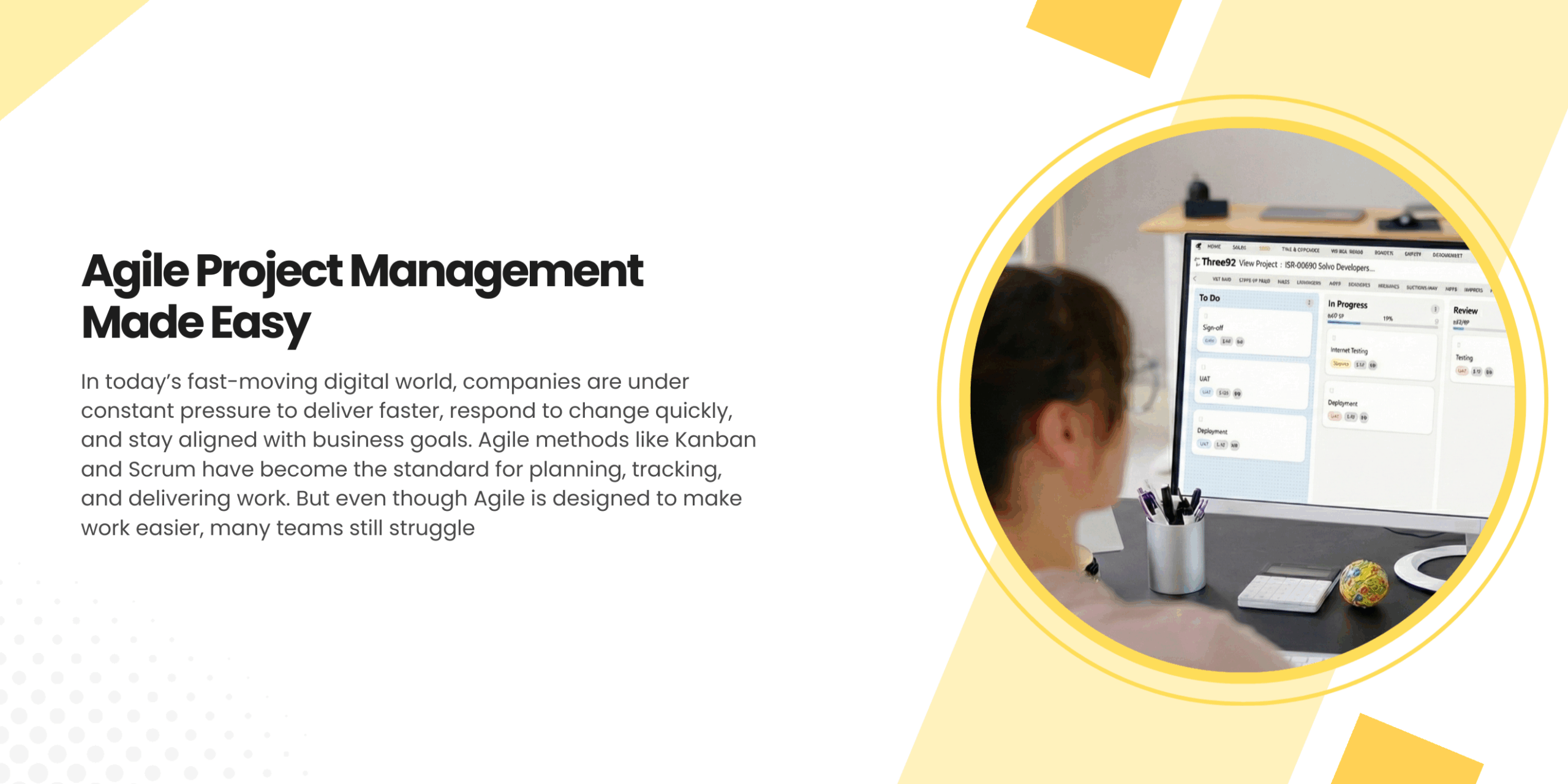
In today’s fast-moving digital world, companies are under constant pressure to deliver faster, respond to change quickly, and stay aligned with business goals. Agile methods like Kanban and Scrum have become the standard for planning, tracking, and delivering work. But even though Agile is designed to make work easier, many teams still struggle.
Most organizations use multiple tools, one for tasks, another for time, another for billing, another for approvals, and often more for reporting or resource planning. This creates a scattered system that slows teams down. People waste time switching tools, data becomes inconsistent, and managers lose visibility into actual progress and performance.
At iBE, we believe Agile should be simple, connected, and directly tied to your business operations. That’s why we’re building Agile capabilities inside our ERP platform. Instead of juggling tools, you get one system for planning, execution, billing, workflow, costing, and performance tracking.
This article explains why Agile inside an ERP matters, what we offer today, the problems teams face, how iBE solves them, and what Agile features are coming next.
Why Agile Matters More Than Ever
Across industries, IT, consulting, engineering, manufacturing, and services—teams are dealing with similar challenges:
- Customers expect faster delivery
- Projects are getting more complex
- Remote and hybrid work require better coordination
- Leaders need real-time insights
- Businesses must balance agility with financial responsibility
Agile practices help teams stay focused, reduce delays, and deliver work in a predictable way. But Agile by itself is not enough. Most companies need more than task management—they need a system that connects Agile work to resources, financials, approvals, workflows, and project KPIs.
This is where traditional tools fall short. Popular platforms like Jira, Trello, and Asana are excellent for tasks, but they do not understand real business data such as project costing, billing, profitability, budgets, or resource allocation.
iBE fills this gap by bringing Agile into the centre of your ERP.
How Different Industries Benefit
1) IT Services & Software Development
Teams in IT and software development face rapid requirement changes, shifting priorities, a unpredictable sprint scopes. iBE helps by supporting:
- Sprint planning, user stories, and story points
- Real-time costing of development tasks
- Developer workload, capacity, and utilization tracking
- T&M vs. fixed-price project billing
- DevOps-style workflow approvals
- Agile delivery tied directly to profitability
2) Consulting & Professional Services
Consulting teams must balance client expectations, deliverables, billable hours, and resource schedules. iBE supports this by offering:
- Clear tracking of deliverables, milestones, and client approvals
- Billable vs. non-billable time tracking
- Resource allocation across multiple engagements
- Profit margin visibility and rate card management
- Time tracking directly linked to billing
- Kanban workflows built for consulting workstreams
3) Engineering, Manufacturing & Project-Based Industries
Engineering and manufacturing teams deal with structured processes, dependencies, and cost controls. iBE helps by enabling:
- Visibility of task dependencies and engineering timelines
- Resource scheduling and load balancing
- Monitoring cost overruns and actual vs. planned effort
- Tracking labor, materials, and work packages
- Workflow approvals for engineering changes
- Agile execution combined with classic project controls
- Burndown insights for engineering deliverables
What iBE Offers Today
We have already launched a powerful, ready-to-use Kanban Board inside iBE, and we are actively designing a complete Scrum Module as our next major milestone.
Kanban: Delivered and Ready to Use
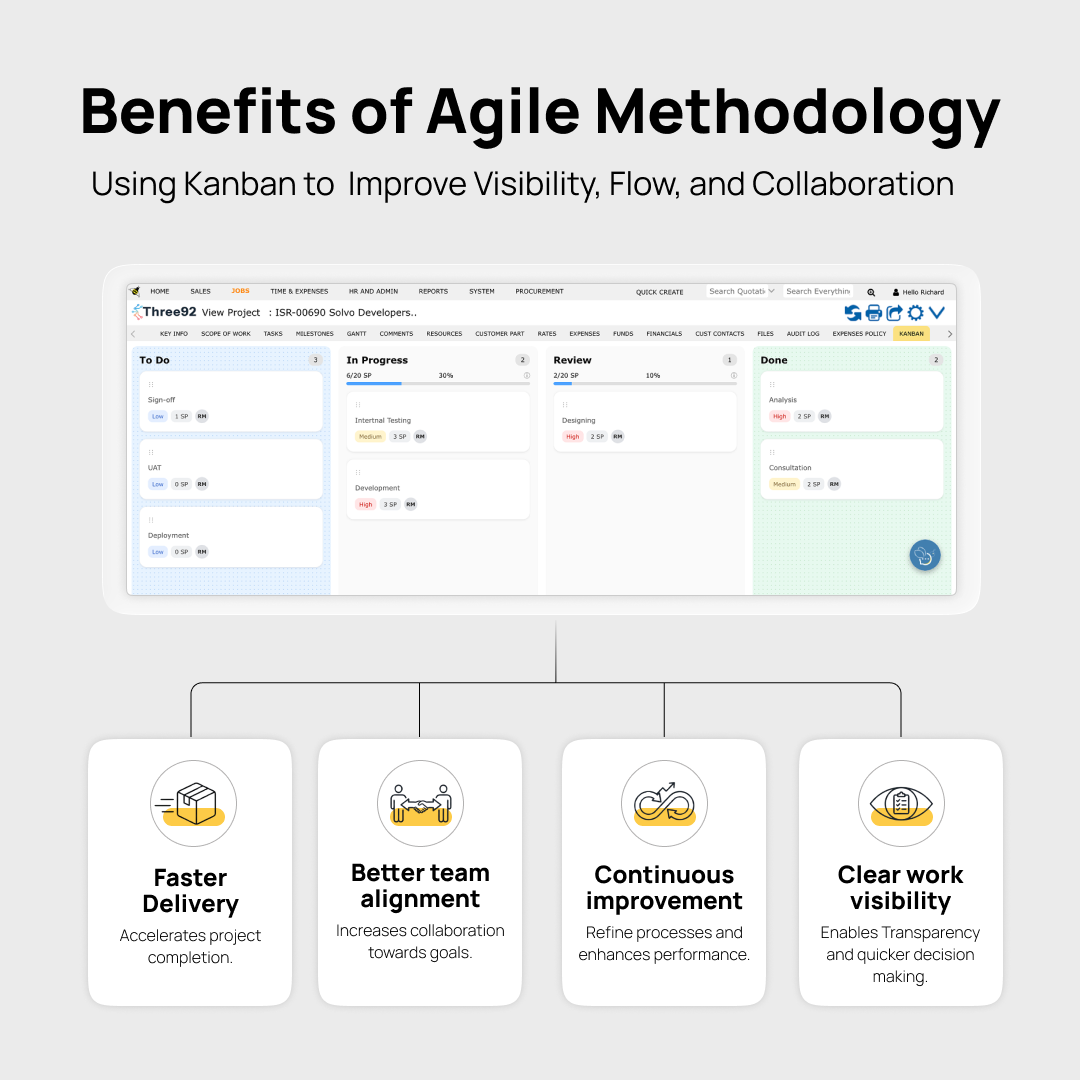
Our Kanban board helps teams manage work visually and clearly. Whether you’re managing sprints, release tasks, tickets, or daily operations, everything is easy to track in one place.
Key Features
- Intuitive Drag-and-Drop
Move tasks between workflow stages and change priority with a simple drag-and-drop action. - Capacity & WIP Limits
Set Work-in-Progress limits to avoid overload and maintain a smooth workflow. Limits can be based on story points or resource availability. - Built-In Resource Assignment
Assign or change task owners directly from the card. Everyone instantly sees who is responsible. - ERP-Backed Data
Every Kanban card connects to real data—resources, billing, approvals, project timelines, and financials.
What Problems Do Teams Face Today?
- Too Many Tools
Teams use separate systems for tasks, time, billing, approvals, and reporting. This leads to duplicate data, syncing issues, confusing reports, and wasted time. - No Single Source of Truth
Different tools show different numbers. Teams need one place to see project status, costs, workload, KPIs, and approvals. Without this, visibility is unclear. - Agile Tools Don’t Understand Business
Most Agile tools can’t track profitability, billing cycles, rates, or project costing. This creates a major gap for project-driven companies. - Too Much Manual Work
Teams spend hours exporting spreadsheets and updating data by hand, causing errors and delays. - Slow Decision-Making
Without real-time information, it’s hard to rebalance work, predict project health, find bottlenecks, or ensure profitability.
How iBE Solves These Problems
- One Unified System
iBE combines Agile tasks, resource planning, timesheets, approvals, billing, costing, profit tracking, and KPIs—everything in one platform. - Business-Aware Agile
Tasks connect directly with business data. Completing work updates KPIs, assignments affect capacity, timesheets affect billing, and approvals move work forward. - Real-Time Visibility
iBE answers key questions instantly: What is being worked on? Who is doing it? How much does it cost? Is the project profitable? - Automation Everywhere
iBE reduces manual effort with automated KPIs, task–timesheet sync, built-in approvals, automated billing, and live resource utilization.
Benefits of Agile Methodology
1) Faster Delivery
Agile speeds up delivery by breaking work into smaller, incremental releases that provide value early and often. Kanban supports this by reducing bottlenecks and keeping work flowing smoothly, which improves cycle time and throughput.
2) Better Team Alignment
Agile creates a shared understanding through ongoing collaboration, ceremonies, and feedback loops. Kanban strengthens this alignment with real-time visibility of responsibilities and priorities, helping teams work together easily.
3) Continuous Improvement
Agile encourages regular reflection to refine processes, improve quality, and respond quickly. Kanban makes these improvements measurable by tracking flow metrics and pointing out inefficiencies that teams can address right away.
4) Clear Work Visibility
Agile promotes transparency so everyone knows about progress and obstacles throughout the project. Kanban visual boards enhance this clarity by showing every task in the workflow, which enables quicker decisions and greater accountability.
Scrum: The Next Milestone
Our upcoming Scrum module will bring:
- Smarter sprint planning
- Resource balancing
- Drag-and-drop backlog management
- Burndown and velocity charts
- Deep integration with billing, costing, and workflows
- Full support for all Scrum ceremonies
“The important thing is not your process. The important thing is your process for improving your process.”
— Henrik Kniberg, Agile/Scrum Coach
Conclusion
Agile project management should not be complicated. It should not require multiple tools or manual syncing. With iBE, your team gets the agility of Kanban and Scrum combined with the power of a full ERP system.
You can plan smarter, work faster, and connect every task to real business outcomes. Whether you’re planning your next sprint, managing team workload, or tracking business performance, iBE makes Agile simple, connected, and scalable.