Securing the Backbone of Your Enterprise
ERP systems are the nerve center of modern enterprises; housing financial records, employee data, supply chain intelligence, and customer information. When this backbone is compromised, the entire organization trembles. Yet ERP security remains chronically underinvested.
Why ERP Security is Uniquely Challenging
Unlike standalone applications, ERP systems integrate dozens of business processes, finance, procurement, manufacturing, HR, and CRM into a single, interconnected platform. This depth of integration is their greatest strength and most dangerous vulnerability.
A single misconfigured role, an unpatched module, or a compromised vendor account can cascade across every connected function. The attacker does not need to breach ten systems; they just need one entry point into the ERP.
KEY RISK
Over 80% of ERP security incidents involve insiders or compromised privileged accounts and not external hackers bypassing firewalls. The threat is often already inside the perimeter.
The Threat Landscape
Understanding the specific threats that target ERP environments is the first step toward building effective defenses. The following table outlines the most prevalent attack vectors:
| Threat | Description |
|---|---|
| Privilege Abuse | Excessive permissions enabling fraud or data leaks, often via Segregation of Duties violations. |
| SQL Injection | Attackers exploit poorly sanitized ERP inputs to query or manipulate the underlying database. |
| Phishing & Social Engineering | Targeted attacks on ERP users to harvest credentials for high-value system access. |
| Third-Party Integration Risk | Unsecured APIs or vendor integrations create hidden entry points bypassing core ERP authentication. |
| Ransomware | Encrypting ERP databases halts entire business operations; a high-leverage ransomware target. |
| Insider Threats | Employees or contractors with legitimate access exfiltrating sensitive financial or HR data. |
Access Control & Identity Management
The single most impactful security control in any ERP environment is robust access management. Role-Based Access Control (RBAC) must be implemented with the principle of least privilege, every user gets only the minimum access required to perform their job function.
Segregation of Duties (SoD) is equally critical. No single user should be able to create a vendor, approve a payment, and reconcile accounts. These conflicting responsibilities must be distributed across different roles to prevent fraud and error.
BEST PRACTICE
Conduct quarterly access reviews. Roles accumulate over time as employees change responsibilities, “role bloat” is one of the most common and dangerous ERP vulnerabilities.
ERP Security Best Practices
Securing your ERP environment requires a layered, disciplined approach. The following best practices form the foundation of a resilient ERP security strategy:
Enforce Multi-Factor Authentication (MFA)
Require MFA for all ERP logins, especially for privileged and remote users. Password-only authentication is insufficient for systems of this criticality.
Patch and Update Religiously
ERP vendors release security patches regularly. A disciplined, tested patch management process is non-negotiable. Unpatched systems are the #1 entry point for known exploits.
Implement Continuous Audit Logging
Every transaction, login, and configuration change should be logged and monitored. Anomaly detection tools can surface suspicious patterns before they become incidents.
Encrypt Data at Rest and in Transit
All sensitive ERP data : financial records, payroll, and PII must be encrypted using industry-standard protocols both in storage and during transmission.
Secure All Integration Points
APIs connecting your ERP to CRM, payroll, or e-commerce platforms must be authenticated, rate-limited, and monitored. Treat every integration as a potential attack surface.
Conduct Regular Penetration Testing
Engage external security professionals to attempt to breach your ERP environment at least annually. Identify vulnerabilities before attackers do.
Train Your Users
Technical controls alone are insufficient. Regular security awareness training, especially around phishing, significantly reduces human-factor risk.
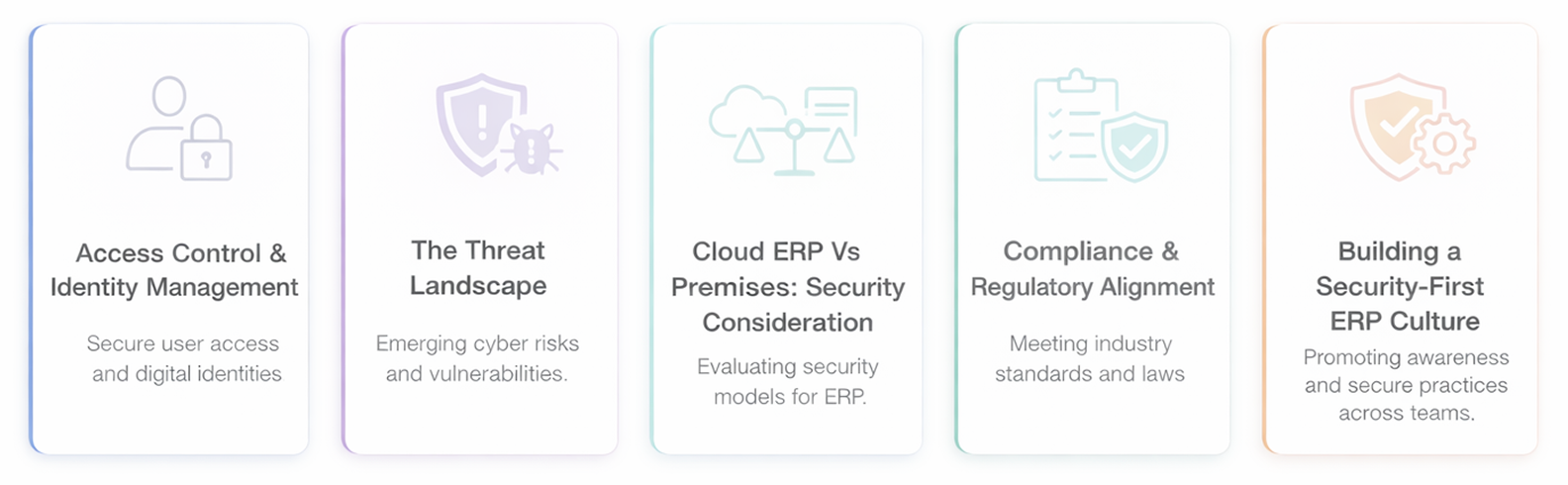
Cloud ERP vs On-Premise: Security Considerations
The shift to cloud-based ERP platforms introduces a shared responsibility model. The vendor secures the infrastructure; the customer secures the data, configurations, and user access.
On-premise deployments offer greater control but demand more internal security resources. Hybrid models, common in large enterprises require careful security architecture to avoid creating blind spots at the connection boundaries.
CRITICAL REMINDER
“Cloud” does not mean “secure by default.” Misconfigured cloud ERP tenants are responsible for a growing share of data breaches. Validate your configurations against CIS benchmarks or vendor security baselines.
Spotlight: iBE.net – Security Built Into the Foundation
A compelling example of security done right at the platform level is iBE.net (www.ibe.net), a cloud-based Professional Services Operations ERP purpose-built for consulting, engineering, IT, and managed service firms. Rather than treating security as a bolt-on feature, iBE.net embeds protection into every layer of its architecture from day one.
iBE.net’s servers are hosted on Amazon Web Services (AWS), one of the world’s most rigorously certified cloud infrastructures. Specifically, the platform runs on Amazon’s SOC 1 (formerly SAS 70 Type II) certified Elastic Cloud, ensuring enterprise-level reliability, uptime, and data protection backed by Amazon’s global security standards.
IBE.NET ON AWS
Hosted on Amazon’s SOC 1-certified Elastic Cloud, iBE.net delivers 24×7 monitored, enterprise-grade infrastructure with built-in encryption, access governance, and continuous protection, without the complexity or cost of managing it yourself.
The table below outlines iBE.net’s key security capabilities and what they mean in practice:
| Security Feature | What It Means for Your Business |
|---|---|
| AWS Infrastructure | Hosted on Amazon’s SOC 1 (formerly SAS 70 Type II) certified Elastic Cloud for enterprise reliability and uptime. |
| Data Encryption | End-to-end encryption protects all data in transit and at rest, keeping communications private. |
| Granular Access Control | Permissions set by role, user group, or document down to specific fields or columns in a table. |
| Session Validation | Continuous session validation prevents unauthorized access and session hijacking. |
| 24×7 Monitoring | Round-the-clock data center monitoring with high-availability architecture built on AWS. |
| Zero IT Burden | Fully cloud-delivered, no patches, no installs, no server maintenance required from your team. |
For professional services firms, iBE.net demonstrates that strong ERP security does not require a large IT department or a complex on-premise setup. When the infrastructure foundation is AWS and the architecture is security-first, enterprise-grade protection becomes accessible to businesses of every size. The result is peace of mind, reduced IT overhead, and a platform your team can trust with your most sensitive operational data.
Compliance & Regulatory Alignment
ERP systems are directly in scope for most major compliance frameworks: SOX mandates controls over financial reporting processes; GDPR governs employee and customer PII stored in HR and CRM modules; HIPAA applies to healthcare organizations using ERP for patient billing.
Security controls that align with these frameworks do not just satisfy auditors, they represent genuine risk reduction. Compliance and security, when approached correctly, are complementary rather than competing priorities.
Building a Security-First ERP Culture
Technology controls are necessary but not sufficient. The organizations with the strongest ERP security postures share a common trait: security is a first-class concern at every level, from the CISO to the individual end user.
This means security requirements are embedded into every ERP customization and integration project. It means access reviews are treated as business-critical processes, not administrative overhead. And it means incident response plans are tested and not just written.
Your ERP is the operational memory of your enterprise. Protect it accordingly.