The Evolution of IT Service Management
For decades, IT Service Management has operated on a foundational principle: every issue triggers a ticket, which is assigned, resolved, and systematically closed. While legacy systems and traditional frameworks have historically served organisations well, the fundamental nature of modern IT and the landscape of digital service delivery have undergone a profound transformation.
Modern business operations span a complex web of cloud platforms, networks, applications, and devices, creating highly intricate customer environments. Consequently, a support ticket is rarely just an isolated incident; it is often the visible symptom of a larger, systemic operational issue. Because of this, the next evolution of ITSM shifts the focus away from managing sheer ticket volume, prioritizing instead a deep, comprehensive understanding of the entire service ecosystem.
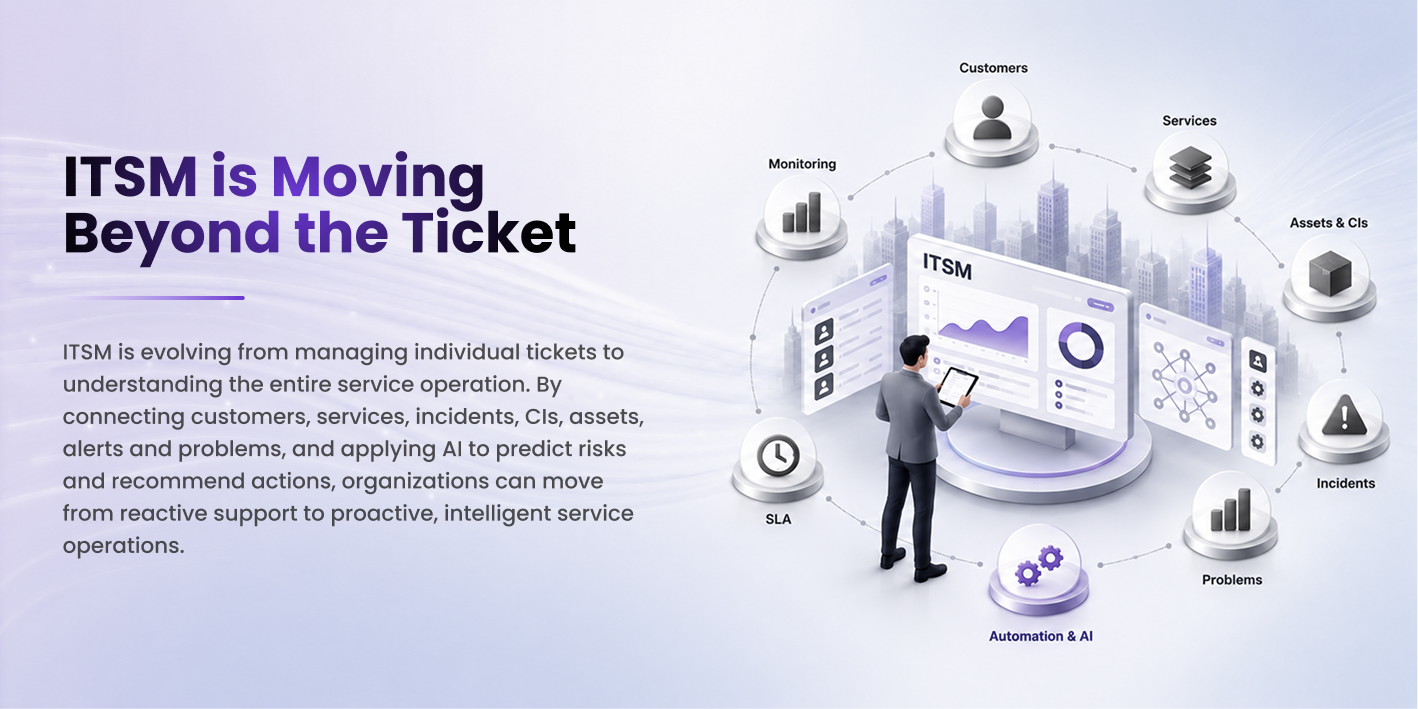
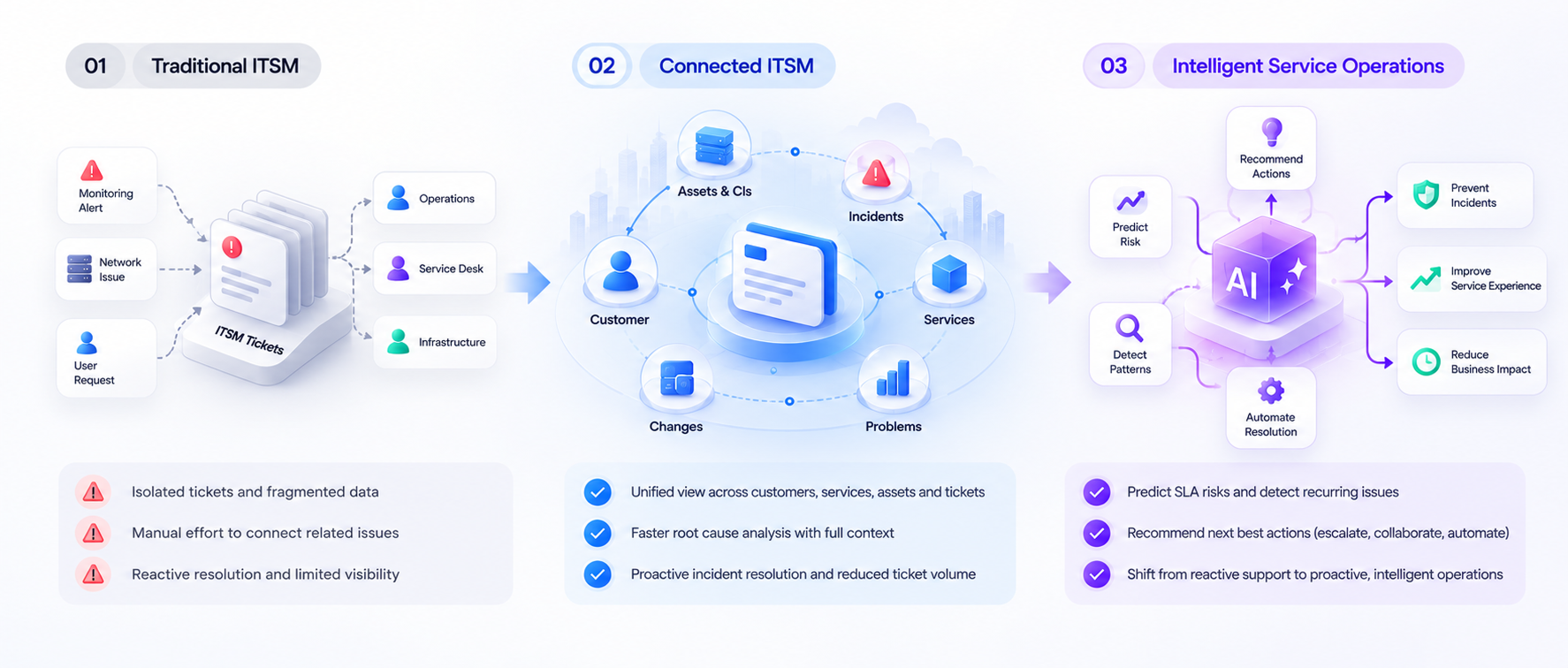
Consider a standard service disruption: a monitoring tool triggers an alert, a network component fluctuates, customer experience degrades, and the service desk faces a sudden influx of calls. In a traditional ITSM environment, these would be treated as isolated events: an infrastructure alert for operations and a huge volume of fragmented tickets for the helpdesk. Teams then waste critical time manually connecting the dots to identify the root cause. Conversely, a connected ITSM approach unifies these disparate signals by linking the customer, the ticket, the active incident, and the underlying configuration item and asset.
The result is a profound paradigm shift: moving away from reactive ticket management toward proactive incident resolution and business impact mitigation.
This distinction becomes vital as service organisations transition from reactive support to predictive operations.
For example, a ticket nearing an SLA breach shouldn’t simply flash red after the deadline passes.
A truly mature system proactively flags a ticket at risk by evaluating a dynamic mix of factors such as:
item age, priority level, historical resolution trends, live team capacity, and remaining SLA time.
When AI is embedded into this workflow, it bridges the gap between insight and execution. It identifies the underlying threat, explains the risk reason, and suggests actionable next steps such as smart escalation, cross-team collaboration, or proactive customer updates.
AI is shifting service desks from transactional ticket resolution to high-velocity decision-making.
The same logic applies to incident and problem management. True operational efficiency isn’t just about closing incidents faster it’s about stopping them from happening again. Too often, organizations trap themselves in a cycle of resolving the same recurring issues, celebrating superficial metrics while missing the broader operational picture. For instance, an intermittent infrastructure glitch might trigger dozens of tickets over several months, yet the business remains focused on transactional workarounds rather than capitalizing on the opportunity to eradicate the root cause. By leveraging connected operational data, teams can automatically surface these hidden patterns and initiate proactive problem management.
This evolves the operational workflow into a far more mature trajectory: moving systematically from isolated incidents, through emerging patterns, to formal problems, until discovering the root cause that enables permanent prevention.
Simultaneously, customer expectations are undergoing a fundamental shift. Today’s customers don’t care which assignment group has their ticket or how many complex internal workflows it passes through. They demand to know: Is my service working? If not, why? When will it be back up, and what do I need to do? This paradigm shift positions the customer portal as a critical element of the ITSM architecture. The digital experience delivered to the user must remain simple, even as the intelligence orchestrating it behind the scenes becomes increasingly sophisticated.
At the same time, the very nature of the ITSM dashboard is changing. Legacy dashboards tell service managers how many tickets are open, how many are closed, and whether SLAs are green or red. Those metrics matter, but they don’t give you the full story. Nowadays, service leaders need to know which services are facing disruption, which customers are impacted, where the operational teams are overloaded, which assets are causing recurring failures, and which tickets or incidents require action before they turn into bigger problems. Because of this, the ITSM dashboard is therefore becoming more like an operations command centre.
The main change is a move from seeing ITSM as a system of record to viewing it as a system of action. Although recording tickets, incidents, problems, assets and SLAs will still be essential, the true potential is in linking that information together and using it to generate operational intelligence.
The system should enable teams to quickly answer four questions:
What is currently happening?
Why is it happening?
What is likely to happen next?
What should we do?
It is in this area that AI and automation can make a real impact; rather than introducing yet another chatbot into a market that is already saturated with such technologies, they should become integrated into the workflows used by service teams. AI should be able to detect patterns, predict risk, correlate events, recommend actions and, where suitable, automate the execution within established controls.
The future of ITSM is therefore to a lesser extent concerned with the ticket itself and to a greater extent with the context surrounding it; the organizations which derive the most value from ITSM will be those that integrate customers, services, incidents, problems, assets, alerts, SLAs and people into one operational picture and who use intelligence to change from reacting to problems to anticipating them.
ITSM is not going away;
instead it is growing to become intelligent service operations.