The Future of Services Businesses in the Age of AI: Operational Intelligence for Elevated Potential
As organizations enter the age of AI Agents, competitive advantage will come not from deploying more AI tools,
but from amplifying Operational Intelligence through Operational Excellence, trusted data, and AI.
Most AI conversations today focus on Generative AI and, increasingly, AI Agents.
While these technologies are transformative, the bigger opportunity lies in how they will change the way services businesses operate.
Professional services firms, engineering organizations, consulting companies, and IT services providers generate enormous amounts of operational data every day.
This data spans every aspect of the business:
- Projects
- Resources
- Financials
- Contracts
- Risks
- Client interactions
Yet many critical decisions are still driven by spreadsheets, periodic reviews, and individual experience.
The challenge is not a lack of data. The challenge is turning operational signals into timely, actionable decisions.
As organizations enter the agentic era, an important realization is emerging:
intelligent systems require more than AI capability. They require trusted data, governance, and operational context.
Without strong operational foundations, AI simply accelerates existing inefficiencies.
Organizations Are Starting from Different Places
The AI conversation often assumes every organization is ready to deploy AI Agents and autonomous workflows.
The reality is very different.
Organizations operate at different levels of maturity.
Some are still building foundational processes and consolidating data.
Others have already established strong Operational Excellence practices and monitor key business indicators in real time.
Their AI journeys will naturally be different.
There is no single AI adoption path.
The Journey from Data to Intelligence
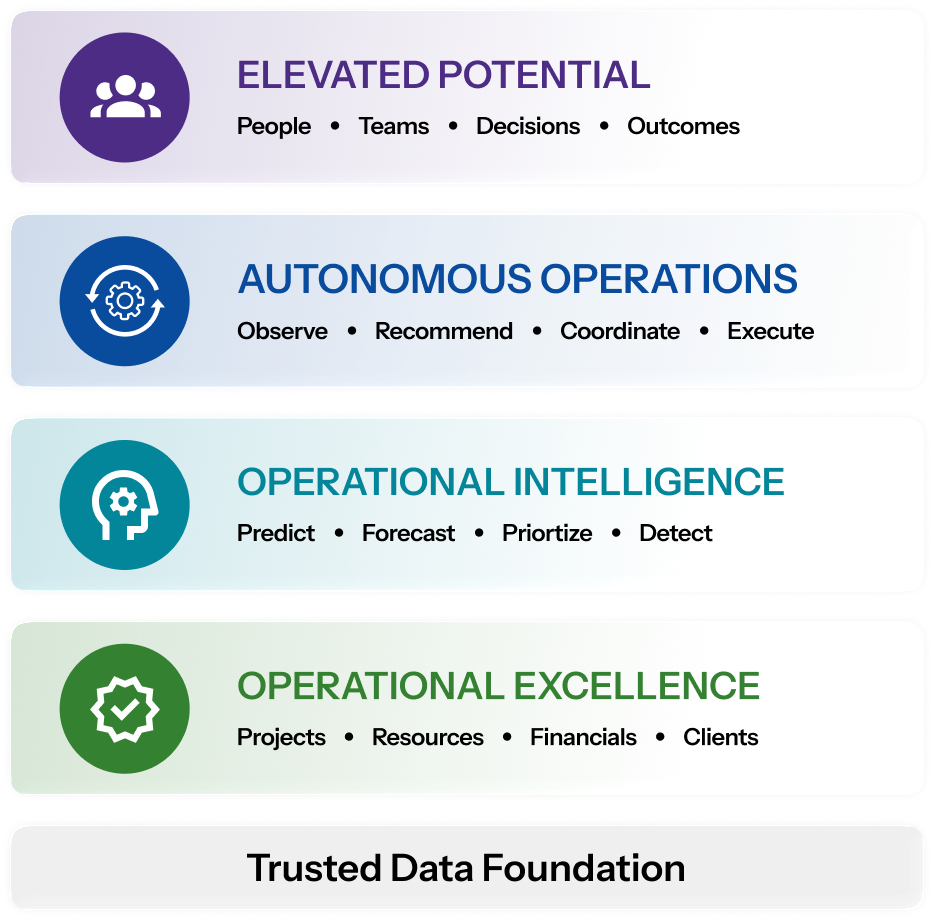
The future of services organizations can be viewed as a progression through multiple stages.
Trusted Data Foundation
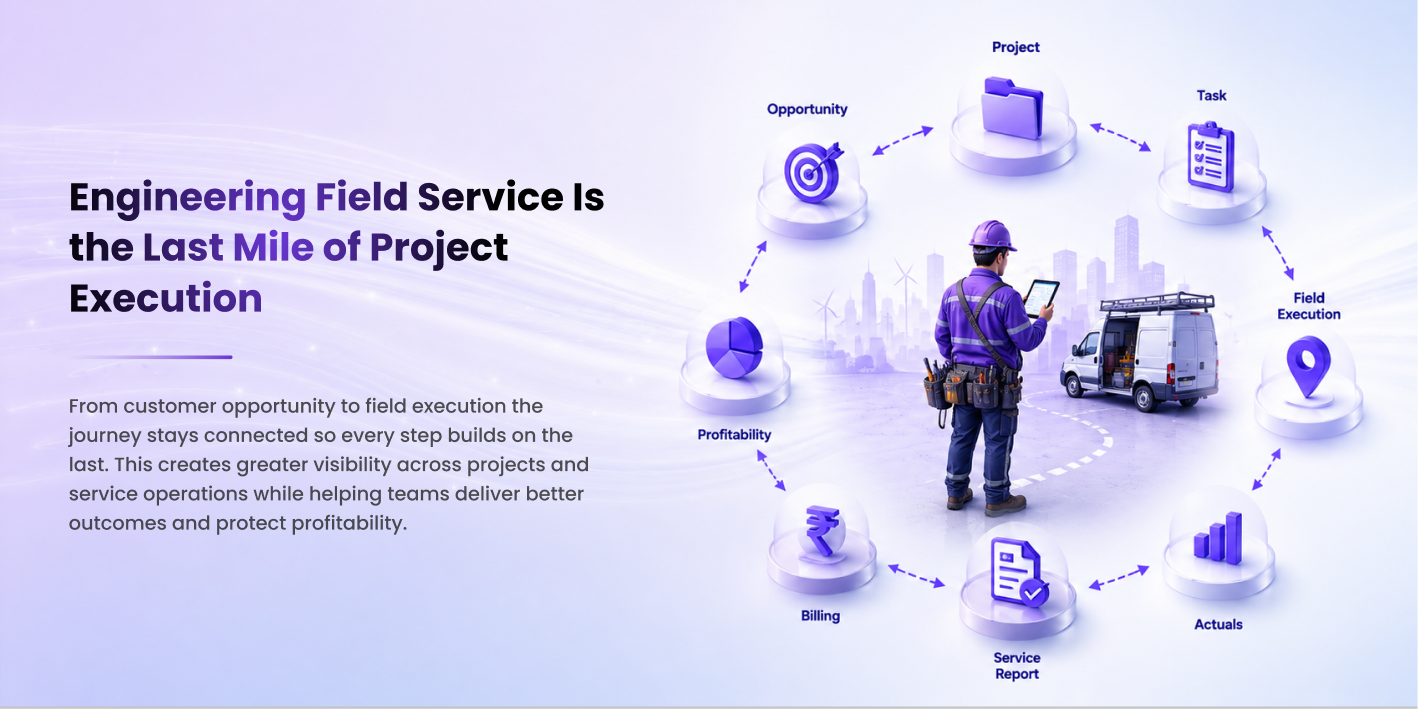
Connect operational data across projects, people, finance, contracts, and client engagements.
This creates visibility and consistency across the organization.
Operational Excellence
Once data is connected, organizations can standardize processes, improve collaboration, and proactively manage performance.
Leaders gain visibility into risks, utilization, margins, and client outcomes.
Operational Intelligence for Sustainable Growth
Organizations move from reactive decision-making to predictive and orchestrated operations.
Leaders constantly ask questions such as:
- Which opportunities are at risk?
- Which projects are falling behind schedule?
- Where are profit margins under pressure?
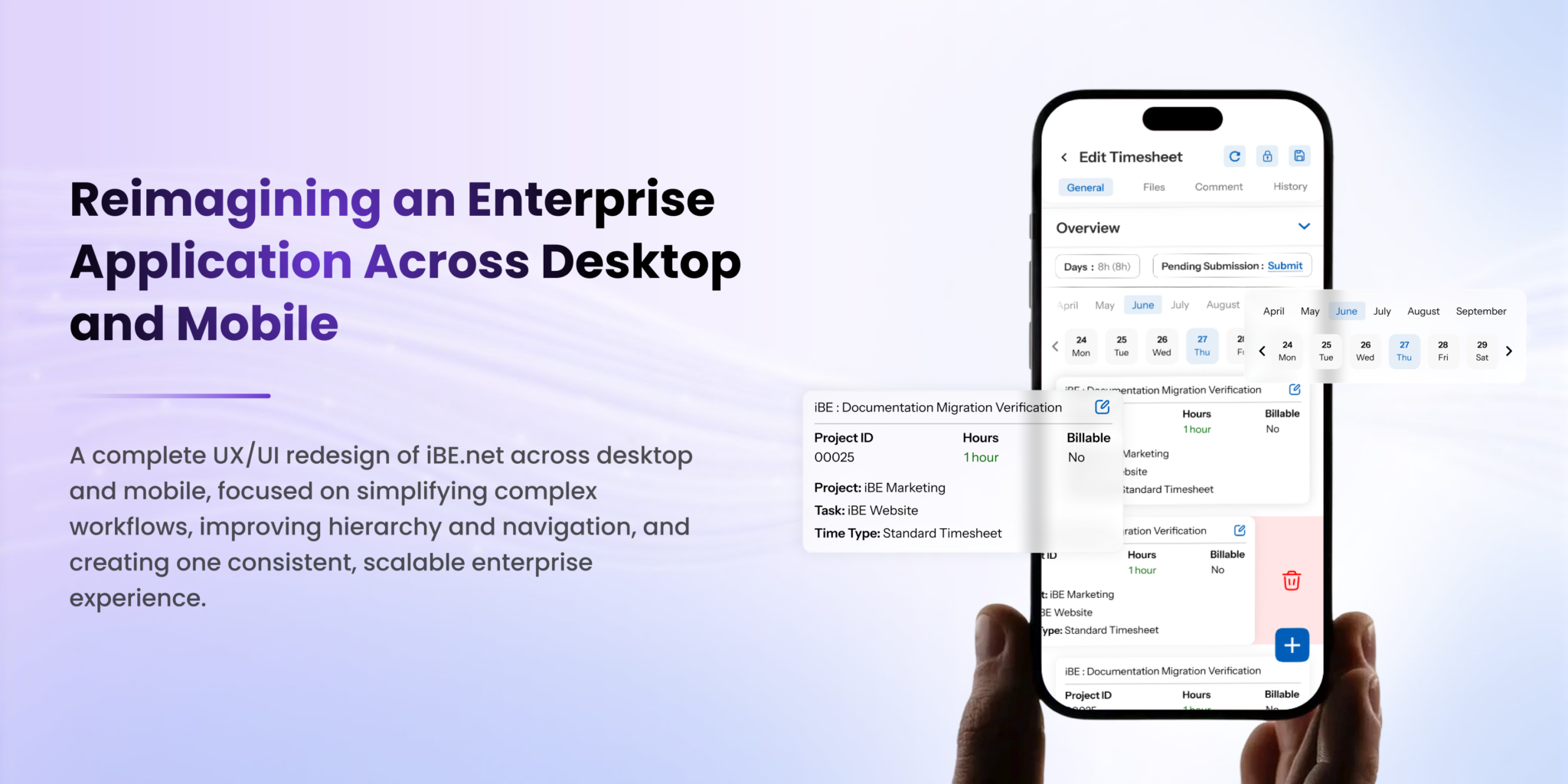
- Which timesheets are missing?
- Which billable hours are at risk?
- Which clients may require intervention?
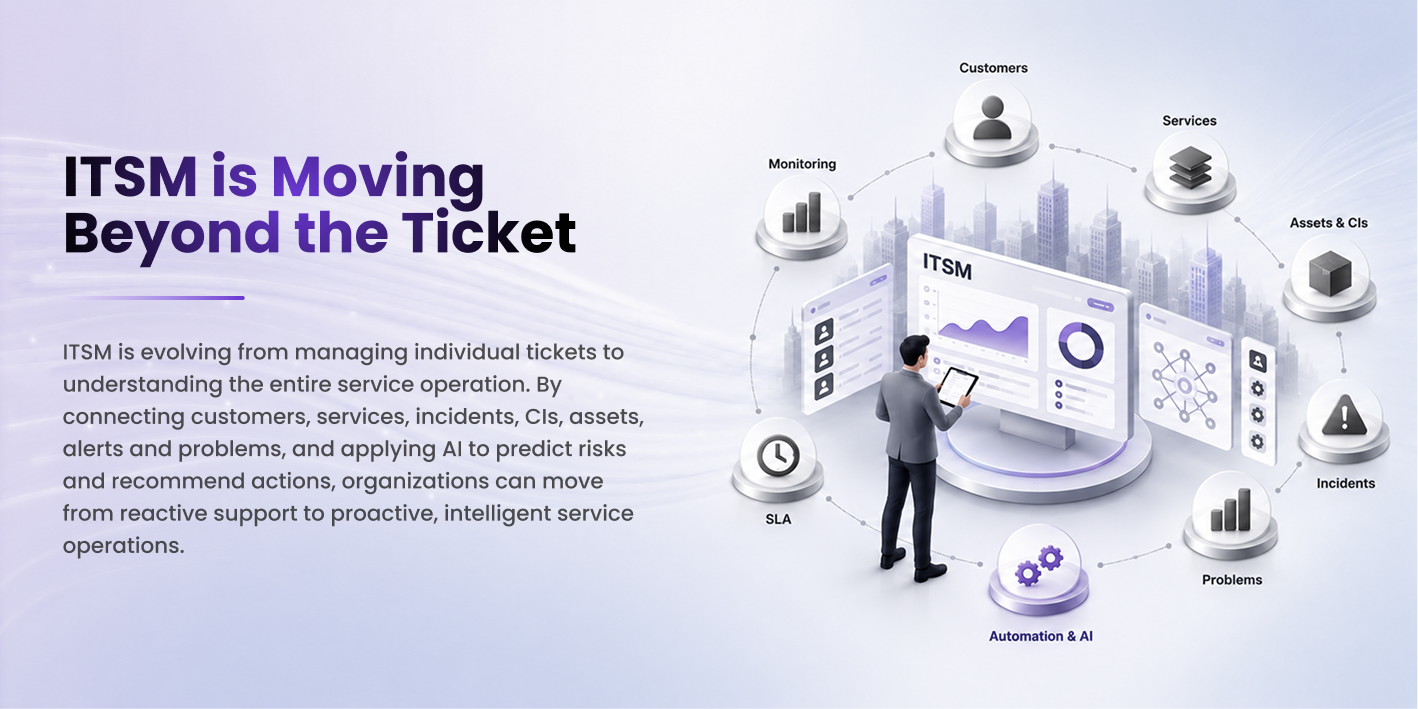
The challenge is not identifying these metrics. The challenge is that this intelligence is often fragmented across reports, dashboards, spreadsheets, and periodic reviews.
Operational Intelligence is business imperative and not aspirational.
The opportunity is to make it continuous, connected, and available across the enterprise.
At iBE, we already enable this in real time. AI now gives us an opportunity to amplify it.
AI as an Amplifier of Operational Intelligence
AI has an important role to play in amplifying Operational Intelligence across services businesses.
Operational Intelligence provides the context that makes AI-driven actions meaningful, enabling organizations to move:
- From reactive to proactive
- From periodic to continuous
- From siloed to connected
- From descriptive to predictive
The evolution of AI in services businesses will move from Assistants,
to Advisors, to Agents.
AI Assistants
Leverage Generative AI to help people create, retrieve, and summarize information.
AI Advisors
Combine Generative AI, analytics, and existing Operational Intelligence to recommend actions and improve decision-making.
AI Agents
Execute and coordinate actions across systems and workflows.
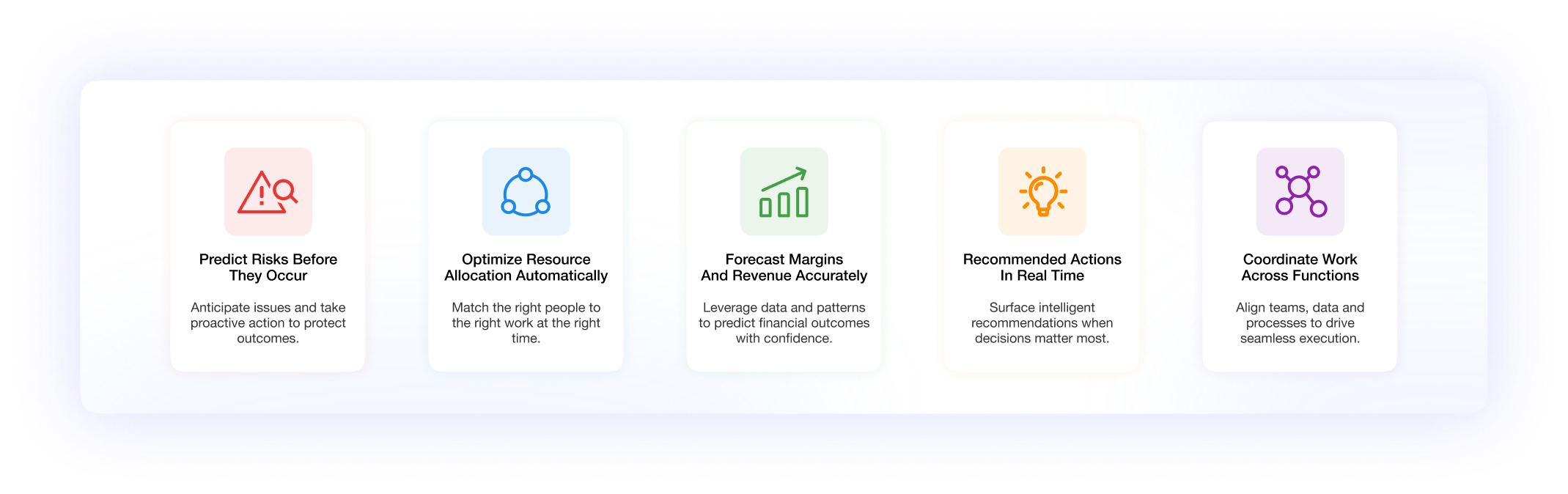
- ✓ Predict risks before they occur
- ✓ Optimize resource allocation proactively
- ✓ Forecast margins and revenue more accurately
- ✓ Recommend actions in real time
- ✓ Coordinate work seamlessly across functions
The goal is not to replace human judgment, but to augment it by making Operational Intelligence available to everyone, everywhere, and when it matters most.
The Next Step: Autonomous Operations
Autonomous Operations should not be interpreted as human-less operations.
Services businesses are fundamentally people-centric businesses.
Clients buy expertise, trust, and relationships.
AI will not replace human judgment. It will elevate it.
The role of AI will be to continuously observe, recommend, coordinate, and execute routine operational activities while humans remain accountable for strategic decisions, client relationships, and business outcomes.
Humans will move from managing tasks to managing outcomes.
AI will automate coordination, not leadership.
From Systems of Record to Systems of Intelligence
For decades, enterprise software has primarily served as Systems of Record.
The next generation of enterprise software will become Systems of Intelligence.
These systems will not simply record what happened. They will help organizations understand what is happening,
anticipate what could happen next, and recommend the actions that should be taken.
Final Thought
The ultimate promise of AI in services businesses is not Autonomous Operations.
It is to amplify Operational Intelligence and elevate the potential of every person,
every team, and every decision across the organization.
The future is not about deploying more AI tools, it is about enabling Operational Intelligence at scale.
Organizations that unite Operational Excellence, trusted data, and AI will transform how services businesses operate, driving smarter decisions, greater efficiency, and lasting competitive advantage.