The Evolution of AI in Services Businesses
From Assistants to Advisors to Agents
The future of AI in services businesses is not just about automation or productivity. It is about transforming operational signals into intelligent actions.
Most organizations began their AI journey by improving individual productivity. AI helped users draft emails, summarize meetings, search documents, and complete routine tasks more efficiently.
The next stage is helping organizations make better decisions by connecting operational data, identifying risks, and recommending actions. Beyond that lies the ability to execute those actions at scale through intelligent automation and coordinated workflows.
This progression represents the evolution from productivity to Operational Intelligence and, ultimately, to operational agility.
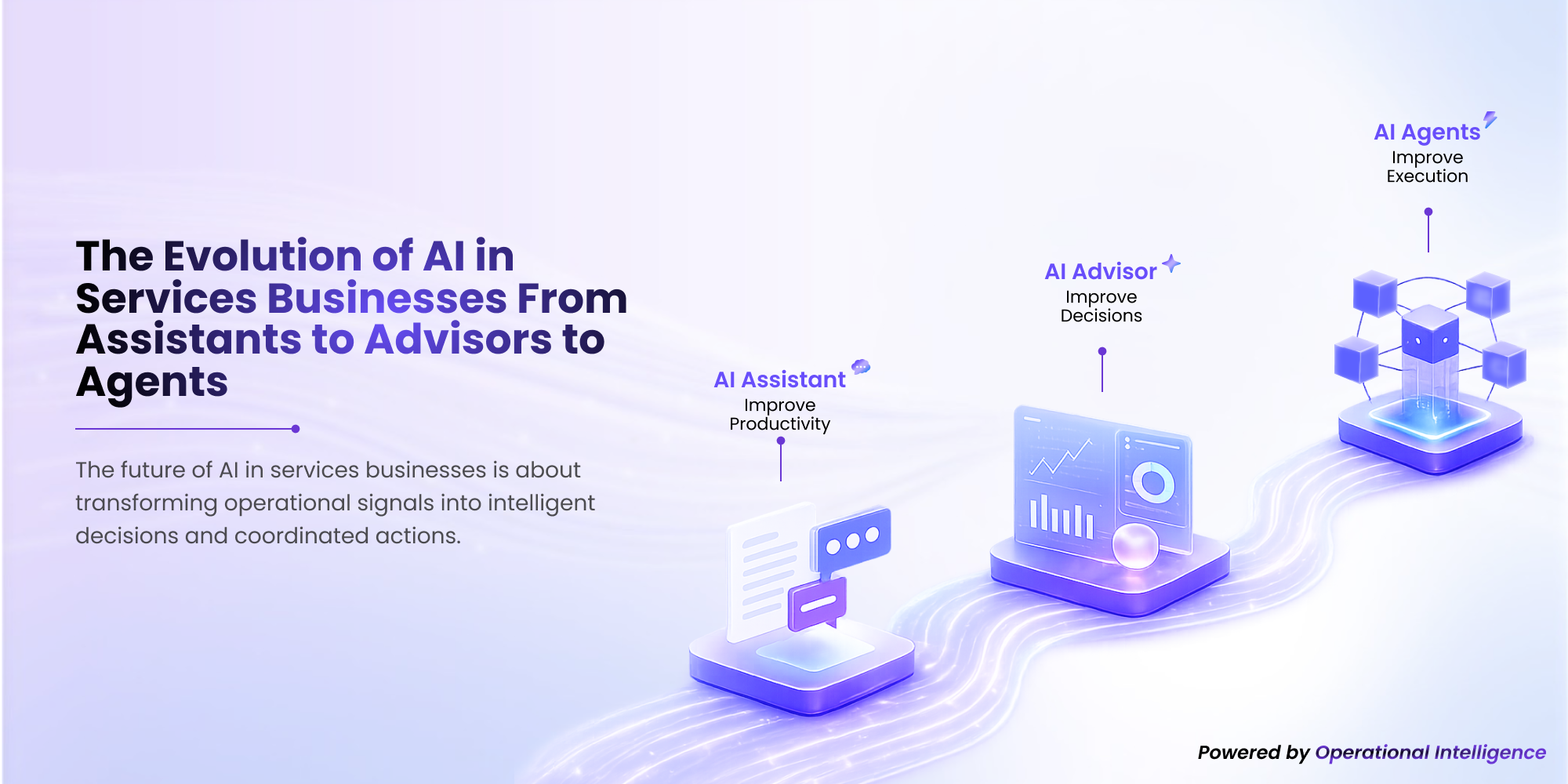
For services businesses, this journey can be viewed through three stages:
Each stage builds on the previous one, creating increasing levels of value and business impact.
AI Assistants: Enhancing Individual Productivity
The first wave of AI focused on helping individuals work more efficiently.
The AI Assistant is an intelligent, conversational interface embedded throughout the application. It enables users to interact with the system using natural language, reducing clicks, automating repetitive work, and surfacing relevant insights. The assistant can understand user intent, access authorized business data, generate content, perform analysis, and help users complete operational tasks.
Powered by Generative AI, AI Assistants retrieve information, summarize conversations, generate emails and reports, and streamline everyday work. They can support a wide range of use cases, from application navigation and contextual help to enterprise search, document analysis, PO-to-quote comparisons, contract reviews, discrepancy detection, resource allocation, project setup, timesheet assistance, and customer communication preparation.
Typical AI Assistant Capabilities
- Application navigation and contextual assistance
- Enterprise search across business data
- Meeting and document summarization
- Email and report generation
- Document and contract analysis
- PO-to-Quote comparison
- Discrepancy detection
- Resource allocation support
- Project setup assistance
- Timesheet guidance
- Customer communication preparation
While AI Assistants significantly improve individual productivity and efficiency, their primary role is to support users in completing tasks. They provide information, insights, and recommendations, but typically do not understand the broader operational context of the business or take ownership of decisions.
In this model, AI assists and humans perform.
AI Assists → Humans Perform
AI Advisors: Operational Intelligence in Action
This is where the real opportunity begins.
Services businesses generate thousands of operational signals every day; opportunities at risk, project health indicators, resource utilization trends, profit margins, revenue forecasts, missing timesheets, and billing exceptions. The challenge is not collecting this information; it is connecting these signals, understanding their business impact, and determining the right course of action.
This is the role of AI Advisors.
Unlike AI Assistants, which primarily help users complete tasks, AI Advisors combine Generative AI, analytics, and Operational Intelligence to understand business context, identify patterns, assess risks, and recommend actions. Rather than simply answering questions, they help decision-makers understand what matters, why it matters, and what should happen next.
Example:
When asked, “Which projects need executive attention this week?”, an AI Advisor can identify delivery risks, explain the underlying causes, estimate the potential financial impact, and recommend corrective actions.
The same approach applies across the business:
- Revenue Advisors improve forecast accuracy and identify opportunities at risk.
- Project Advisors detect delivery issues before they affect customers.
- Resource Advisors optimize utilization, capacity, and skill allocation.
- Profitability Advisors uncover margin pressures and revenue leakage.
- Executive Advisors surface cross-functional insights that require leadership attention.
This is Operational Intelligence in action not just reporting what happened, but helping leaders decide what to do next.
In this model, AI advises and humans decide.
AI Advises → Humans Decide
AI Agents: Turning Decisions into Action
Once organizations can consistently make better decisions, the next step is execution.
This is where AI Agents create value.
AI Agents build upon the foundation established by AI Assistants and AI Advisors. While Assistants help users complete tasks and Advisors recommend actions, Agents coordinate and execute those actions within defined business processes and governance controls.
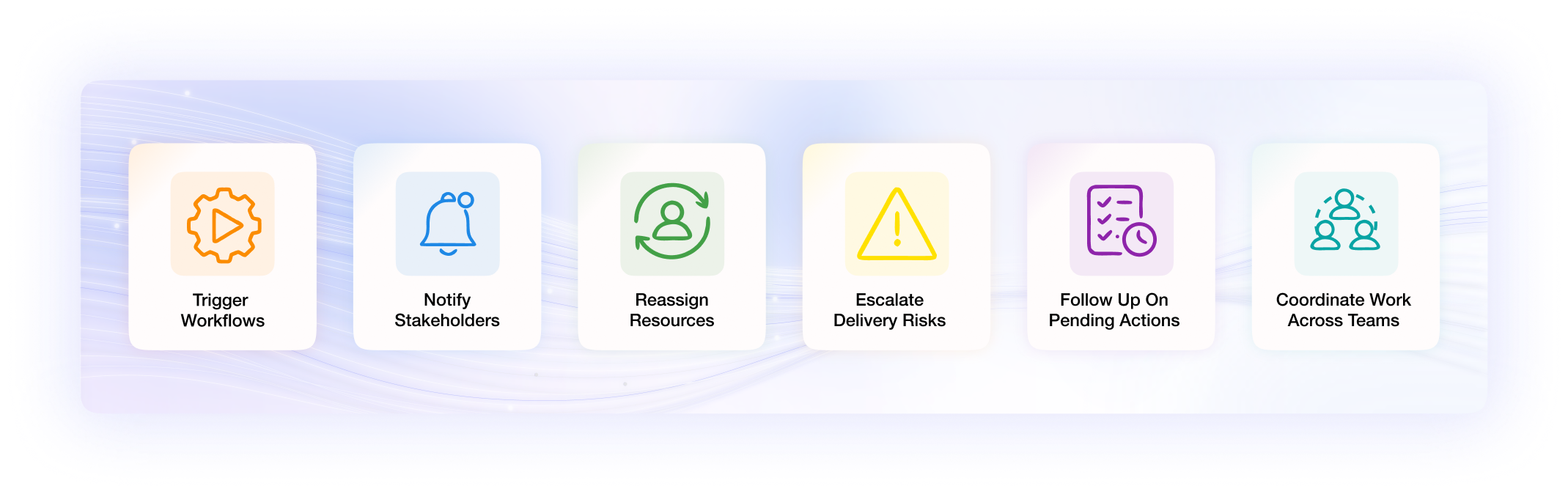
An AI Agent can trigger workflows, notify stakeholders, reassign resources, escalate delivery risks, follow up on pending actions, and coordinate activities across teams. By combining business context, Operational Intelligence, and automation, Agents can act on insights and drive outcomes with minimal human intervention.
As organizations mature, multiple specialized agents can work together across functions, connecting sales, delivery, finance, and operations. These agents continuously monitor operational signals, respond to changing conditions, and coordinate actions in real time, enabling the business to operate with greater speed, consistency, and agility.
This is Operational Agility in action not just helping people work or decide, but enabling the organization to execute at scale.
In this model, AI executes and humans govern.
AI Executes → Humans Govern
The Journey Is About Business Maturity
The evolution from AI Assistants to AI Advisors to AI Agents is not simply about adopting new AI technologies. It represents a progression in business capability and organizational maturity.
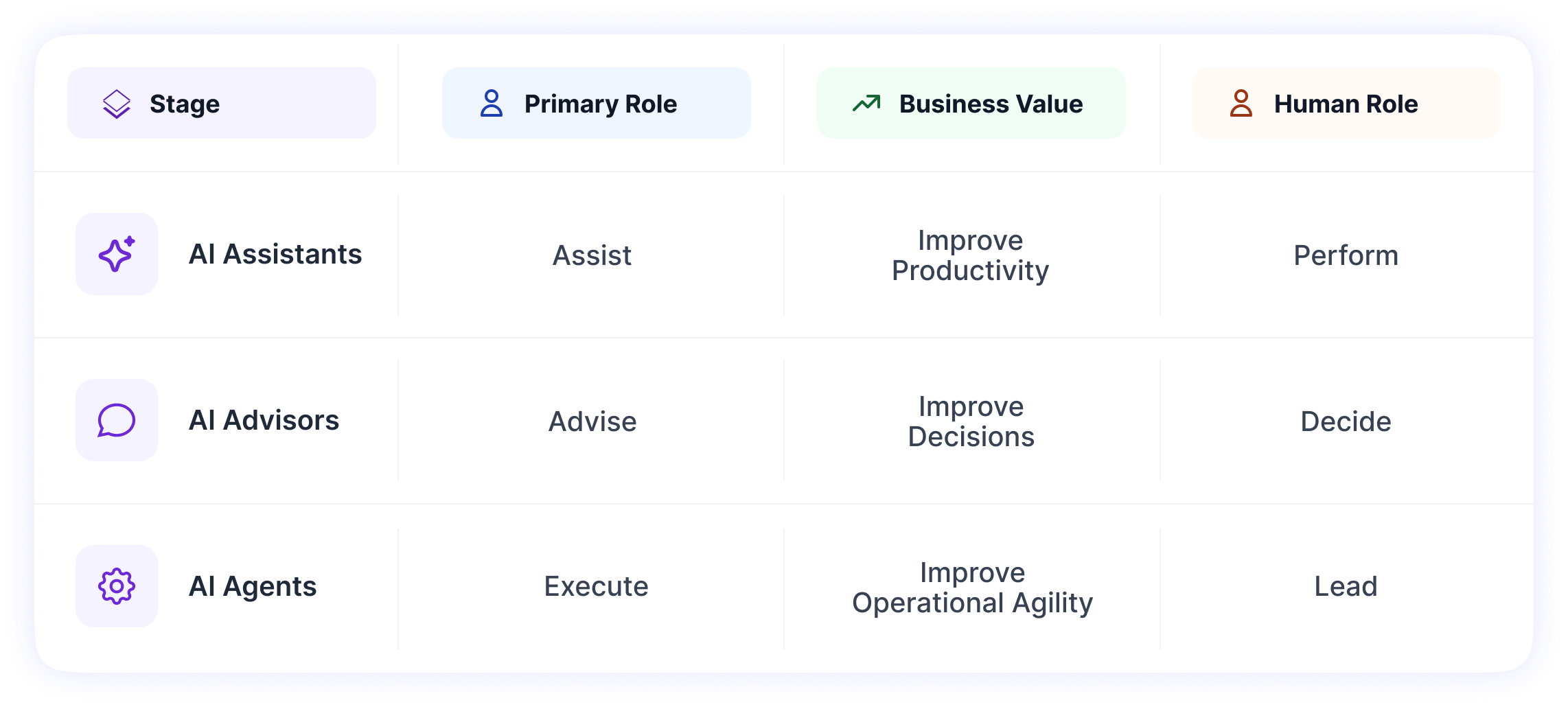
Each stage builds upon the previous one.
AI Assistants help individuals work more efficiently by reducing effort and accelerating access to information.
AI Advisors help organizations make better decisions by connecting data, identifying risks, and recommending actions.
AI Agents help organizations execute more effectively by coordinating activities, automating processes, and responding to operational events in real time.
This evolution is not about replacing people. It is about elevating their contribution. As AI takes on greater responsibility for assistance, analysis, and execution, people can focus more on judgment, leadership, innovation, and strategic direction.
AI evolves from Assisting → Advising → Executing
Humans evolve from Performing → Deciding → Leading
Looking Ahead
The greatest opportunity for services businesses is not simply adopting AI Assistants, AI Advisors, or AI Agents in isolation. It is creating the foundation that allows them to work together effectively.
That foundation starts with trusted data and strong Operational Excellence. When operational signals are connected across sales, delivery, resources, finance, and customer success, organizations gain the visibility needed to generate meaningful insights. Those insights become Operational Intelligence the bridge between data and action.
The Connected AI Operating Model
AI Advisors → Transform Operational Intelligence into better decisions
AI Agents → Turn those decisions into coordinated execution
Together, they create a new operating model for services businesses; one where people, Operational Intelligence, and AI continuously work together to improve performance, agility, and outcomes.
Organizations that embrace this evolution will move beyond productivity gains and toward a future of intelligent, adaptive, and increasingly autonomous operations.
Next in the Series
In our next article, we will share our perspective on why AI will not replace people, it will elevate human potential. We will explore how AI can help individuals and organizations make better decisions, respond faster to change, uncover new opportunities, and solve increasingly complex challenges.