
What It Really Takes to Deliver Defect-Free ERP And Keep Customer Experience Awesome
In an era where businesses are rapidly embracing artificial intelligence for smarter forecasting, automation, and predictive decision-making, ERP systems remain the structured foundation that powers those innovations. Enterprise Resource Planning systems are not just software applications; they are the operational backbone of organizations. While AI enhances intelligence and drives strategic insights, it is the ERP that manages financial transactions, payroll, procurement, sales, inventory, compliance, reporting, and the very pulse of day-to-day business activity. In many ways, AI and ERP complement each other, AI adds intelligence, but ERP ensures control, accuracy, and operational discipline.
When an ERP system fails, it doesn’t simply inconvenience users, it disrupts operations, delays payments, impacts revenue, and shakes confidence across departments. Delivering defect-free ERP software, therefore, is not about technical excellence alone. It is about safeguarding business continuity and ensuring that customers experience reliability, clarity, and confidence from day one.
Behind every smooth ERP implementation lies a rigorous, thoughtful testing process that goes far beyond clicking buttons and logging bugs.
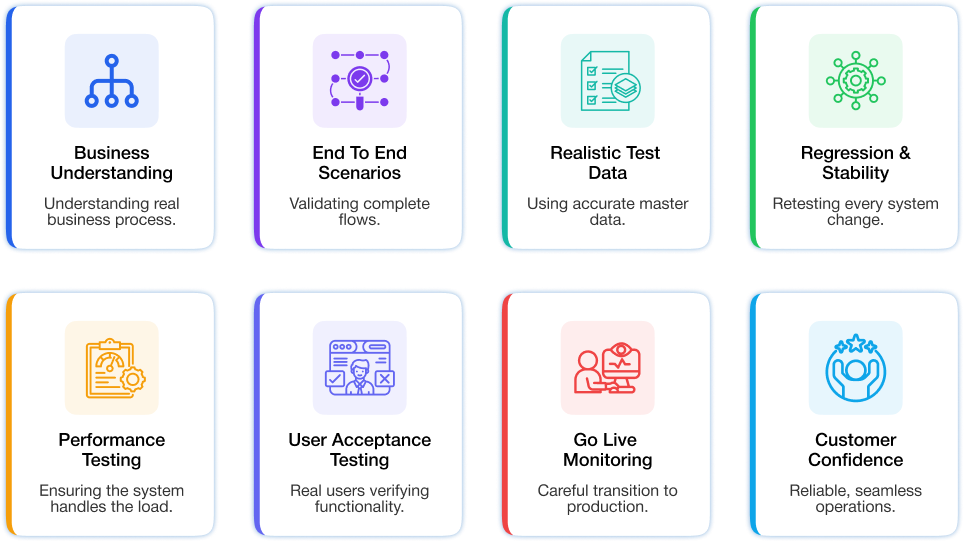
Understanding Business Before Testing Software
ERP testing begins long before execution scripts are written. It starts with understanding the business.
Unlike standalone applications, ERP systems are deeply intertwined with real organizational processes. Finance teams rely on accurate ledger postings. Procurement teams depend on approval workflows. Sales teams expect seamless order processing. Inventory managers need real-time stock visibility.
Testing such a system requires contextual awareness. Without understanding how month-end closing works, how revenue is recognized, or how taxes are calculated, it becomes impossible to validate whether the system truly functions as intended.
A defect in ERP software is rarely isolated. A small configuration error in tax logic can cascade into financial misstatements. A workflow misalignment can delay procurement. Testing must therefore align with business reality, not just technical requirements.
The Impact of AI on ERP Systems
The ERP landscape is being transformed by Artificial Intelligence. AI-driven forecasting, predictive maintenance, anomaly detection, intelligent approvals and chat-based assistants are becoming embedded features.
While AI introduces efficiency and intelligence, it also introduces new testing complexities. Algorithms must be validated not just for functionality, but for accuracy and reliability. Predictive models must be assessed against historical data. Automated decision-making must align with business policies.
Testing AI-enabled ERP features requires additional layers of validation, examining data quality, bias detection, exception handling, and transparency in automated recommendations.
AI enhances ERP systems, but it also raises the bar for quality assurance.
End-to-End Thinking, Not Screen-by-Screen Validation
ERP systems operate as connected ecosystems. A single transaction often touches multiple modules across departments.
A sales order may trigger inventory allocation, shipment creation, invoicing, revenue posting, and financial reporting. Testing only the sales screen would miss downstream impacts that surface later in accounting or analytics.
True ERP quality assurance focuses on complete business journeys. Order-to-cash, procure-to-pay, record-to-report, these flows must be validated from initiation to completion.
Defect-free delivery depends on this holistic validation. Issues often hide in integrations, handoffs, and transitions between modules rather than within individual screens.
The Critical Role of Realistic Test Data
One of the most overlooked aspects of ERP testing is test data preparation.
Accurate validation requires realistic data structures, properly defined chart of accounts, valid tax codes, organizational hierarchies, approval matrices, vendors, customers, and inventory masters. Without this foundation, testing becomes superficial.
Poor data leads to false confidence. Realistic data exposes edge cases. It reveals how the system behaves under practical business conditions, including complex scenarios such as multi-currency transactions, partial deliveries, intercompany postings, and backdated entries.
The strength of ERP testing often depends on the strength of its data setup.
Regression: Protecting Stability Through Change
ERP systems are rarely static. Enhancements are introduced. Patches are applied. Configurations evolve. With every change comes risk.
A minor update in workflow logic can unintentionally affect financial approvals. A tax rule modification might disrupt invoicing. An integration tweak could impact reporting accuracy.
Regression testing acts as a safeguard. It ensures that core business processes remain intact despite ongoing changes. Stability is maintained through disciplined revalidation of critical scenarios
Defect-free delivery is not a one-time achievement; it is sustained through consistent verification.
Performance Is Part of the Experience
Functionality alone does not define quality. Performance plays a critical role in customer experience.
ERP systems often face peak operational loads, payroll processing, month-end closings, large-scale data imports, reporting cycles, and simultaneous user activity across departments. If the system slows down during these high-pressure periods, productivity suffers.
Testing must simulate real-world usage patterns. Load testing, stress validation, and background job monitoring help ensure the system performs reliably under pressure.
An ERP platform that is accurate but sluggish still damages user satisfaction. Smooth performance reinforces trust.
Communication and Collaboration Define Success
ERP testing is inherently collaborative. Functional consultants, developers, infrastructure teams, and business stakeholders must work in alignment.
Defect reporting requires clarity and business awareness. A logged issue must explain not only what failed but why it matters. Highlighting financial impact, compliance risks, or operational consequences allows teams to prioritize effectively.
Strong communication reduces turnaround time and prevents misunderstandings. It ensures that fixes address root causes rather than surface symptoms.
Quality emerges from collective effort, not isolated testing activities.
User Acceptance Testing: The Reality Check
Even the most thorough internal validation cannot replace User Acceptance Testing (UAT). This is where real users execute real scenarios based on daily tasks.
UAT often uncovers unexpected edge cases or usability concerns. Sometimes the system functions correctly from a technical standpoint but feels unintuitive to end users.
Delivering an awesome customer experience requires attention to these subtle signals. Clear error messages, intuitive workflows, and logical navigation contribute significantly to user confidence.
When users feel comfortable operating the system without excessive support, adoption improves naturally.
Go-Live Is Not the Finish Line
The transition to production is a critical milestone, but not the end of quality assurance.
The first financial closing cycle, the first payroll run, the first tax filing, these events test the system in real operating conditions. Close monitoring during this phase ensures that configurations behave as expected and integrations remain stable.
Post go-live vigilance reinforces customer trust. Prompt issue resolution and proactive validation prevent small problems from escalating.
Defect-free delivery extends beyond deployment.
What Defect-Free Really Means
In complex ERP ecosystems, absolute perfection is unrealistic. However, risk-controlled stability is achievable.
Defect-free delivery means eliminating critical blockers before they reach customers. It means ensuring financial accuracy, data integrity, compliance adherence, and operational continuity.
It also means minimizing friction. When users can process transactions without confusion, generate reports without discrepancies, and rely on system data without second-guessing, the objective has been achieved.
The absence of disruption becomes the strongest indicator of success.
The Human Side of ERP Quality and the Road Ahead
Technology powers ERP systems, but people depend on them. Finance teams trust the numbers they present. Operations rely on accurate inventory. HR depends on payroll precision. Every user expects reliability because their work — and credibility — is tied to it.
Testing ERP software is ultimately about protecting that trust.
An awesome customer experience is not accidental. It is built through disciplined validation, realistic business scenarios, collaboration across teams, and constant attention to business impact. Behind every seamless transaction is structured testing. Behind every accurate report is verified logic. Behind every confident user is a system strengthened long before go-live.
At iBE, delivering exceptional ERP experiences goes beyond deployment. It combines structured testing methodologies with business-driven validation, AI readiness, and cloud-optimized quality practices to ensure systems are stable, secure, and future-ready.
As AI advances and cloud ecosystems expand, ERP systems are becoming more intelligent and predictive. The future lies in adaptive platforms that anticipate business needs rather than simply respond to them. Ensuring these systems remain reliable and user-centric will define the next era of quality assurance.
At iBE, the commitment is clear: blending innovation with reliability and technology with empathy to deliver ERP solutions that not only function flawlessly but create truly awesome customer experiences.