Seamless Continuity: From Lead to Opportunity to Project
Winning an opportunity is a critical milestone, but it is not the finish line.
The real measure of success lies in how effectively that opportunity is executed as a project.
For many organizations, the journey from:
Opportunity
Project
is fragmented across systems, teams, and processes.This fragmentation introduces risk includes Loss of information, Misalignment of commitments, Rework during execution
In an environment where customer expectations are high, continuity is no longer optional, it is essential.
The Journey and Where It Breaks
Capturing Intent
At the lead stage, organizations gather early insights:
- Customer needs
- Business context
- Initial expectations
This is where the foundation of the relationship is established.
Defining Commitment
As leads mature into opportunities, clarity increases:
- Scope is defined
- Commercials are agreed
- Estimations are created
These estimations include:
- Effort and timelines
- Resource planning
- Cost structures
This stage is not just about selling, it is about designing delivery.
Delivering Value
Once the deal is closed, execution begins.
However, in many organizations:
- Estimations remain locked in CRM or spreadsheets
- Delivery teams rebuild plans independently
- Work Breakdown Structures (WBS) are recreated
The Limitation of Traditional CRM Approaches
Platforms like Salesforce Sales Cloud are highly effective in managing:
- Leads and opportunities
- Pipelines and forecasting
- Customer interactions
However, their primary focus remains on sales processes.
When an opportunity is won:
- The transition to project delivery often requires external tools
- Data must be manually transferred or reinterpreted
- Estimations do not automatically translate into execution structures
This creates a dependency on integrations, increasing:
- Complexity
- Risk of data loss
- Operational inefficiencies
The iBE Approach: From Opportunity to Execution Without Breaks
An integrated platform like iBE eliminates this gap by combining:
- CRM
- Estimation
- Project Management
into a single, unified environment.
Opportunity → Project Conversion with Context
In iBE:
- Opportunity-level estimations directly convert into WBS
- Tasks, effort, and timelines are automatically structured
- Resource plans are carried forward
There is no need to:
- Recreate plans
- Reinterpret assumptions
- Duplicate data
From Estimation to WBS: Preserving What Matters
The critical advantage lies in continuity of estimation.
Instead of treating estimation as a pre-sales activity, iBE ensures it becomes the foundation of execution.
This means:
- Every task in the WBS is traceable to an estimate
- Every estimate retains its underlying assumptions
- Financial and operational plans remain aligned
The result is simple but powerful:
What is estimated is what is executed.
The Impact on Business Outcomes
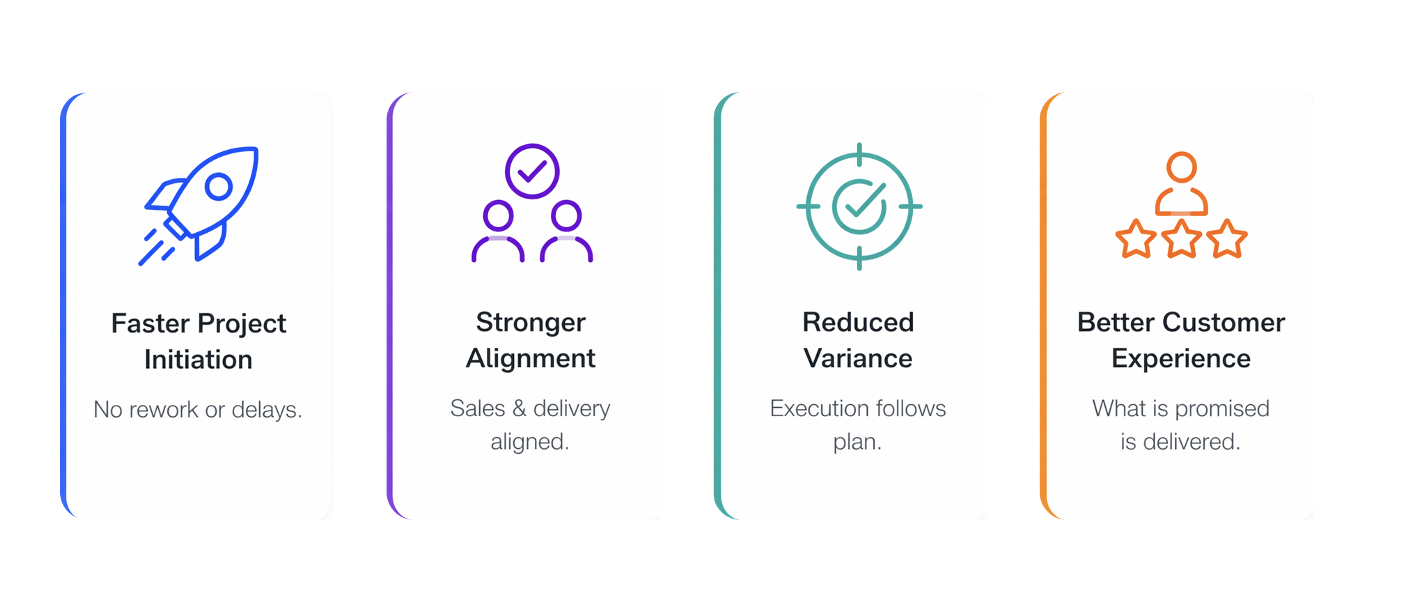
Faster Project Initiation
Projects start with complete, structured data, no delays or rework.
Stronger Alignment
Sales and delivery operate on the same dataset, eliminating ambiguity.
Reduced Variance
Execution closely follows planned effort, cost, and timelines.
Improved Customer Experience
Clients experience consistency, what was promised is what is delivered.
Beyond CRM: Enabling True Business Continuity
The difference is not just in features, it is in approach.
Traditional CRM systems optimize selling.
Integrated platforms like iBE optimize selling and delivering as one continuous lifecycle.
This shift enables organizations to move from:
Conclusion
The journey from lead to opportunity to project is not a sequence of disconnected stages.
It is a single, integrated lifecycle that must preserve:
- • Information
- • Estimation
- • Commitment
Organizations that rely on fragmented systems will continue to face:
- Misalignment
- Inefficiencies
- Delivery risks
Those that adopt an integrated approach will achieve:
- Seamless execution
- Stronger financial control
- Consistent customer experience
Because in the end,
Success is not defined by closing deals,
it is defined by delivering them exactly as planned.
Are your opportunity estimations driving your project execution or getting lost in transition?
Move beyond disconnected CRM systems.
Adopt an integrated business environment where every opportunity seamlessly becomes an execution-ready project.