Engineering Field Service Is the Last Mile of Project Execution
Why engineering services companies need to connect opportunity, project execution, field service and profitability
For engineering services organizations, field service is often viewed as the final step in the delivery process. An opportunity is won, a project is created, tasks are planned, and eventually an engineer goes to the customer site to complete the work. The engineer submits a service report, time and expenses are recorded, and the project moves toward closure. While this process appears straightforward, the reality is often much more fragmented. Information moves between sales, project management, service operations, field engineers and finance, with each function operating from a different perspective of the same customer engagement.
This fragmentation creates a fundamental visibility problem. What was promised to the customer during the sales process may not always remain visible to the project team. What was planned in the project may not be visible to the field engineer. What actually happened in the field may take days to reach the project manager or finance team. By the time management sees the impact on cost, schedule or customer satisfaction, the opportunity to intervene may already have passed.
Field service, therefore, should not be treated as a standalone operational function. It is the last mile of project execution.
The journey starts before the engineer reaches the customer
In a modern engineering services organization, the service journey often begins with an opportunity. A customer may require equipment installation, commissioning, calibration, maintenance, inspection, repair or another specialized engineering service. The opportunity captures the commercial commitment: what the customer needs, what the organization has agreed to deliver, and under what commercial terms.
Once the opportunity is won, that commitment becomes a project. The project translates the commercial promise into executable work, with tasks, resources, schedules, milestones and expected costs. Some of those tasks may be performed remotely or within the organization, while others require an engineer to be physically present at the customer’s location.
This transition from opportunity to project to field execution is where many organizations lose continuity. The information exists, but it is distributed across systems and teams. The result is a series of handoffs rather than a continuous service lifecycle.
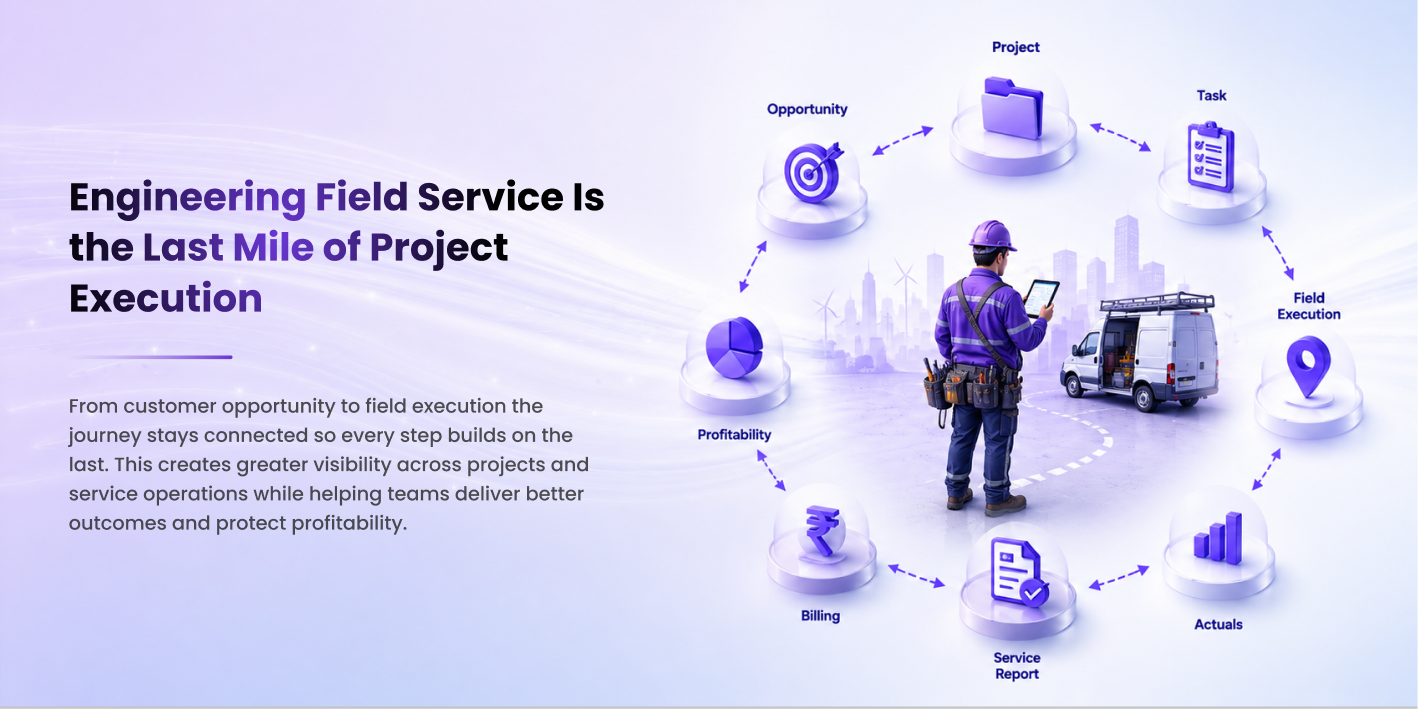
A more connected model treats the entire journey as one flow:
Opportunity → Project → Task → Field Execution → Actuals → Service Report → Billing → Profitability
The value is not simply in automating each step. It is in maintaining the context as work moves from one step to the next.
Field execution is where the customer promise becomes reality
The field engineer represents the point at which the commercial and operational commitments made to the customer become tangible. Giving an engineer only a task description is rarely enough for complex engineering work. The engineer needs to understand the customer, the equipment, the scope of work, previous service history, required skills, relevant documentation, parts and tools, and the expected outcome.
This is particularly important in equipment-intensive engineering services. A machine, measurement system or technical instrument may have a service history spanning many years. Previous calibration results, maintenance activities, breakdowns, replaced components and engineer findings can all influence the next service engagement.
When this context is available to the engineer at the point of execution, the field visit becomes more informed and more effective. When it is disconnected, the engineer is forced to reconstruct the context manually, often through emails, documents or conversations with colleagues.
The field service application therefore should not simply tell an engineer where to go and when to go there. It should provide the operational context required to execute the work successfully.
The asset becomes part of the customer relationship
For many engineering services companies, the equipment being serviced is as important as the customer itself. The relationship may continue for years through maintenance, calibration, upgrades, inspections and repairs.
A connected service model allows every field activity to contribute to the equipment’s history. Each visit can add information about what was observed, what was repaired, what components were replaced, how long the work took, and what recommendations were made.
Over time, this creates a much richer picture of the asset. The organization can identify recurring failures, increasing service effort, maintenance patterns and potential future requirements. The service history becomes more than a record of completed jobs; it becomes a source of operational and customer intelligence.
Execution should flow back into the project
The connection between project and field service should work in both directions. The project should provide the field engineer with the context required to execute the work, but field execution should also provide the project with an accurate view of what actually happened.
If a task estimated at four hours requires eight hours, that variance matters. If additional parts are required, that matters. If another site visit becomes necessary, that matters. If the engineer identifies additional work that the customer requires, that may create a new opportunity.
When actual field activity flows back into the project in near real time, project managers can identify deviations earlier and take corrective action while there is still time to influence the outcome.
This is particularly important for project profitability. Engineering services businesses can lose margin not because the original opportunity was poorly priced, but because actual execution gradually diverges from the assumptions made during estimation and planning.
The ability to see what was sold, what was planned, what was executed and what it actually cost is therefore fundamental to managing a profitable service organization.
Resource planning must consider capability, not just availability
Engineering field service also exposes another important challenge: scarce technical expertise.
The question is not simply whether an engineer is available. The organization needs to determine whether that engineer has the right skills, certifications, product knowledge, customer familiarity and geographic availability for the job.
Connecting field service with resource planning enables organizations to move from availability-based scheduling toward capability-based assignment. This becomes increasingly important as engineering services become more specialized and customers expect increasingly sophisticated technical expertise.
The goal is not to find the first available engineer. It is to identify the right engineer for the job while balancing customer commitments, utilization, travel and operational capacity.
The service report should become part of the operational record
The service report is often treated as an administrative document produced after the work is completed. In a connected service environment, it becomes much more valuable.
The report can bring together the work performed, time spent, parts consumed, measurements, findings, photographs, recommendations and customer acknowledgement. When this information is connected to the project, customer and equipment records, it becomes part of the organization’s long-term operational knowledge.
That information can support future service planning, warranty decisions, quality processes, customer communication and follow-on opportunities. More importantly, it eliminates the need to reconstruct service history every time a customer or piece of equipment requires attention.
The real value is visibility across the entire service operation
For an operations leader, the mobile experience is only one part of the equation. The larger requirement is visibility across the service organization.
Leadership needs to understand which projects are progressing as planned, which field activities are delayed, where engineering capacity is constrained, which jobs are approaching their SLA, which projects are consuming more effort than expected, and which completed activities have not yet been converted into billable work.
This level of visibility is difficult when customer, project, resource, field service and financial information live in separate systems. It becomes significantly more powerful when these relationships are maintained in one operational flow.
The result is a shift from asking teams for status updates to managing the business through a shared view of execution.
Connected execution creates the foundation for practical AI
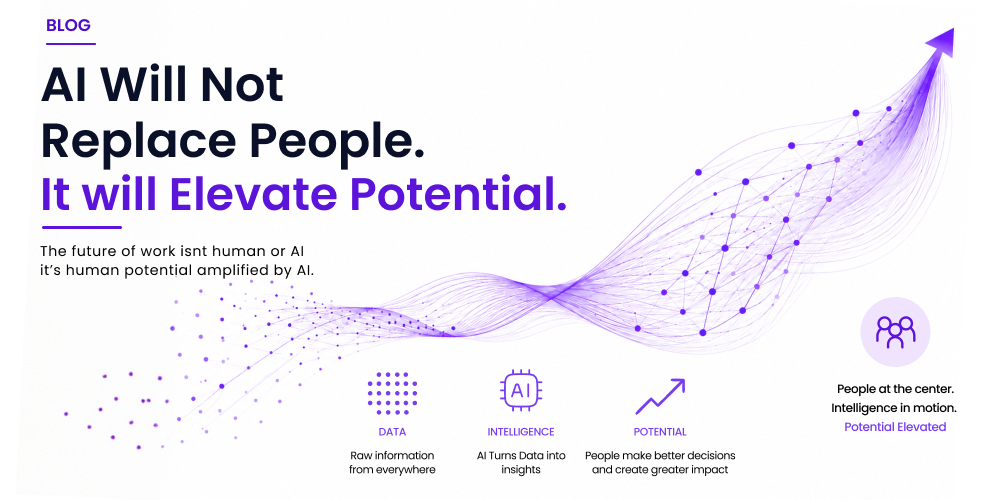
AI will increasingly influence how engineering services organizations plan and execute field work, but the value of AI depends heavily on the quality and context of the underlying data.
An AI model can identify that an engineer is unavailable. A connected operational platform can understand that the engineer is unavailable, that another engineer has the required certification, that the second engineer is already scheduled nearby, that the job has an SLA risk, and that the project is already exceeding its planned effort.
That context enables AI to move beyond generic recommendations toward useful operational decisions.
AI can help identify projects at risk, recommend suitable resources, detect unusual service costs, highlight recurring equipment problems, predict potential SLA breaches and identify follow-on service opportunities.
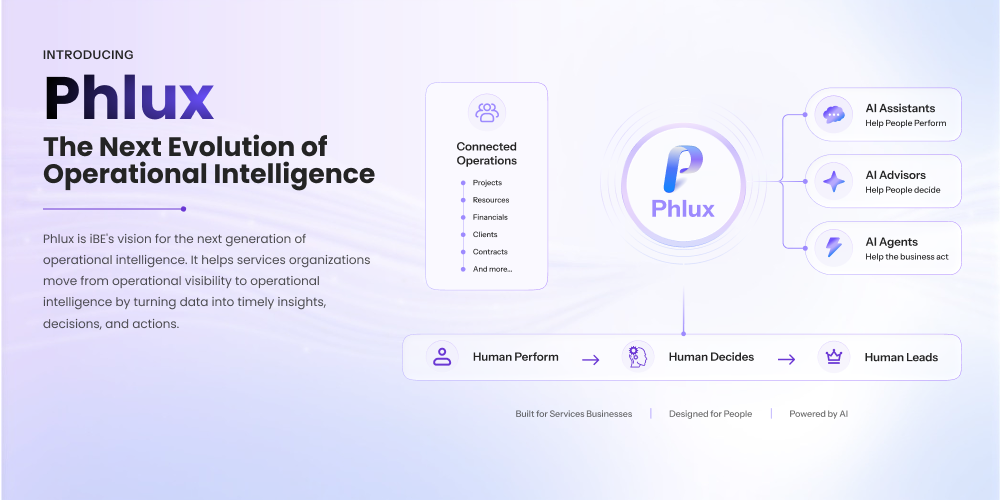
The opportunity is therefore not simply to add AI to field service. It is to create the connected operational foundation that makes AI useful.
A new way to think about engineering field service
The traditional view of field service is simple: dispatch an engineer, complete the job and close the work order.
For modern engineering services organizations, that definition is too narrow.
Field service is part of a much larger business lifecycle that begins with the customer opportunity and continues through project planning, task execution, service reporting, costing, billing and profitability.
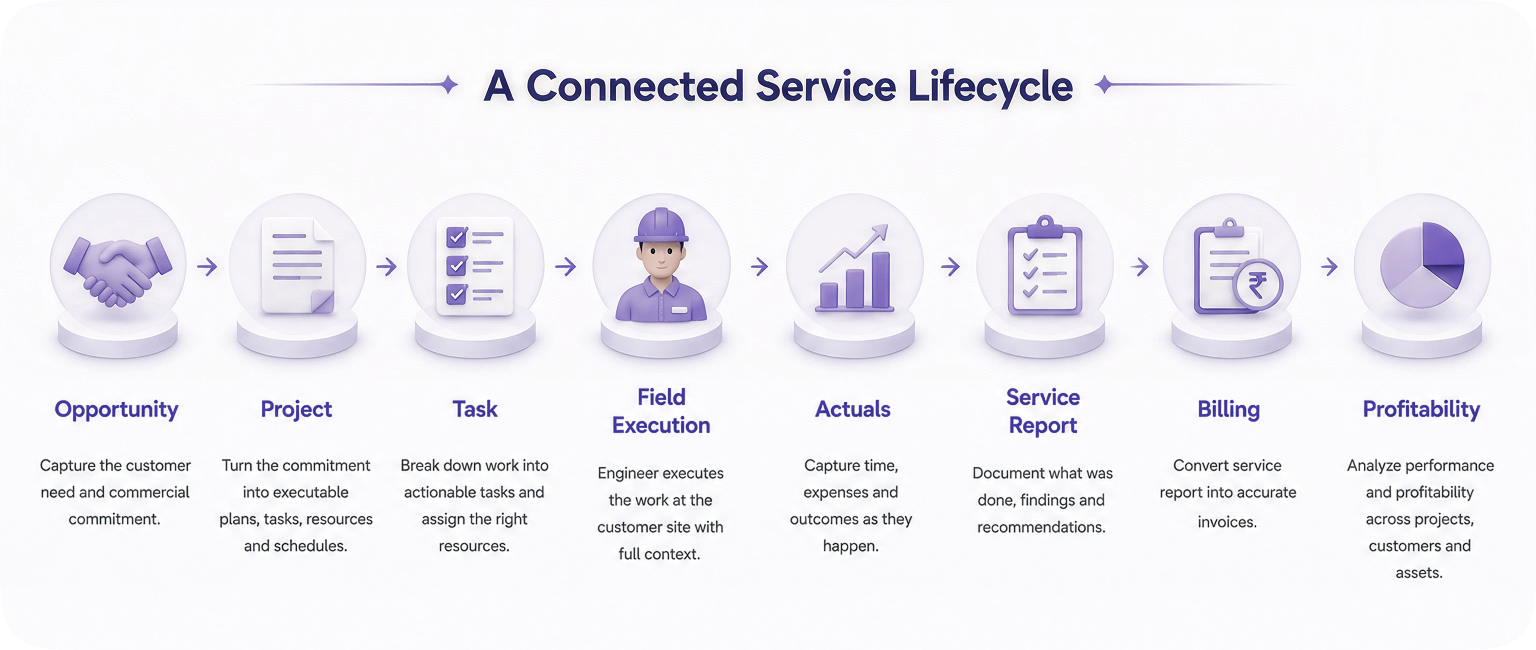
When these stages are connected, every part of the organization benefits. Sales retains visibility into what was committed. Project managers can see what is actually being delivered. Engineers receive the context they need to execute effectively. Operations gains visibility into capacity and risk. Finance has better visibility into actual billable activity. And customers receive a more consistent and transparent service experience.
Where iBE fits
This is the philosophy behind iBE’s approach to engineering field service. Rather than positioning field service as a standalone scheduling or mobile application, iBE connects field execution with the broader engineering services lifecycle.
An opportunity can become a project. A project can become executable tasks. Tasks can be assigned to the right engineering resources and executed in the field. Actual time, expenses and parts can flow back into the project. Service reports can become part of the customer and equipment history. And the resulting operational data can support billing, profitability analysis and AI-driven insights.
The result is a continuous operating model rather than a collection of disconnected applications.
From what was sold, to what was planned, to what was delivered, to what it cost.
That is the visibility engineering services organizations need to scale service delivery without losing control of execution or profitability.
The future of engineering field service is connected execution
Engineering services companies are being asked to deliver faster response, greater transparency and more predictable outcomes while managing increasingly specialized resources and complex customer requirements.
The answer is not necessarily another standalone application.
It is a connected operating model in which the customer opportunity, project, task, engineer, equipment, field activity, service report, cost and billing record remain part of the same story.
Field service is the last mile of project execution.
When that last mile is connected to everything that came before it and everything that follows it becomes much more than a field activity.
It becomes a strategic source of
customer value, operational visibility and profitability.